
University of Wisconsin-Madison biochemist Karl Paul Link and his lab isolated an anticoagulant compound from spoiled sweet clover hay in 1939, after a Wisconsin farmer's cattle began hemorrhaging from the moldy feed. Their research led to warfarin, marketed first as a rat poison in 1948 and later approved as the blood-thinning drug warfarin sodium (Coumadin) in 1954. It remains one of the world's most widely prescribed anticoagulants.
Innovation designated by: 
The University of Wisconsin Collection, The American Chemical Society
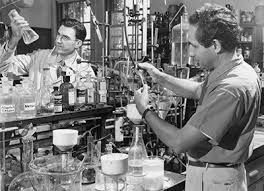
Mark A. Stahmann (left) and Karl Paul Link discovered dicumarol, a powerful anticoagulant. They are shown in 1940 in a UW-Madison biochemistry laboratory.
Courtesy of The University of Wisconsin Collection
Courtesy of The University of Wisconsin Collection
Address:
420 Henry Mall
Madison, WI, USA
420 Henry Mall