
Beginning in 1961, at what was then the Ramo-Wooldridge Corporation, the dedicated employees of Space Park designed and built more than 100 of the world’s most technically challenging satellites, rocket engines and astronomical observatories.
1961
Society: AIAAMain Category: Aerospace & AviationSub Category: AerospaceEra: 1960-1969DateCreated: 19611 Space Park DrRedondo BeachState: CAZip: 90278Country: USAWebsite: https://aiaa.org/about-aiaa/history-heritage/historic-aerospace-sites/Creator: Ramo-Wooldridge Corporation
YearAdded:
Image Credit: Funhistory; Wikipedia; CC0; American Institute of Aeronautics and AstronauticsImage Caption: Space Park Quad
2011
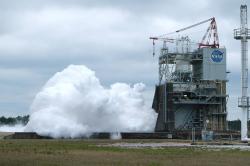
This rocket propulsion test complex was created to flight-certify all first and second stages of the Apollo Saturn V rocket. The first test-firing occurred on April 23, 1966. Subsequent to the Apollo Program, these test stands were modified to support the testing requirements of the Space Shuttle Main Engine. Every astronaut who traveled to the moon aboard Saturn V Rockets and into space aboard the Space Shuttle, did so on rocket stages and engines that were first proven flight-worthy on these test stands.
YearAdded:
Image Caption: J-2X Engine No. 10002 is test fired for the final time on the A-1 test stand at NASA’s Stennis Space Center.
2007
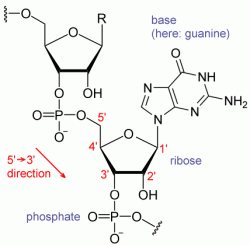
In 1961, in the National Institutes of Health Headquarters (Bethesda, MD), Marshall Nirenberg and Heinrich Matthaei discovered the key to breaking the genetic code when they conducted an experiment using a synthetic RNA chain of multiple units of uracil to instruct a chain of amino acids to add phenylalanine. The uracil (poly-U) served as a messenger directing protein synthesis. This experiment demonstrated that messenger RNA transcribes genetic information from DNA, regulating the assembly of amino acids into complex proteins.
YearAdded:
Image Credit: Courtesy Wikipedia/Infocan (CC BY-SA 3.0)Image Caption: Deciphering the Genetic CodeEra_date_from: 1961
1997
Innovations
In 1961, in the National Institutes of Health Headquarters (Bethesda, MD), Marshall Nirenberg and Heinrich Matthaei discovered the key to breaking the genetic code when they conducted an experiment using a synthetic RNA chain of multiple units of uracil to instruct a chain of amino acids to add…
Read More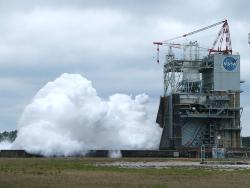
This rocket propulsion test complex was created to flight-certify all first and second stages of the Apollo Saturn V rocket. The first test-firing occurred on April 23, 1966. Subsequent to the Apollo Program, these test stands were modified to support the testing requirements of the…
Read MoreBeginning in 1961, at what was then the Ramo-Wooldridge Corporation, the dedicated employees of Space Park designed and built more than 100 of the world’s most technically challenging satellites, rocket engines and astronomical observatories. The technologies they developed and continue to…
Read More