
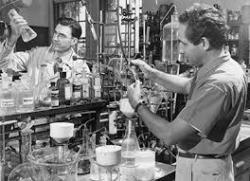
University of Wisconsin-Madison biochemist Karl Paul Link and his lab isolated an anticoagulant compound from spoiled sweet clover hay in 1939, after a Wisconsin farmer's cattle began hemorrhaging from the moldy feed. Their research led to warfarin, marketed first as a rat poison in 1948 and later approved as the blood-thinning drug warfarin sodium (Coumadin) in 1954. It remains one of the world's most widely prescribed anticoagulants.
Poison
YearAdded:
Image Credit: The University of Wisconsin Collection, The American Chemical SocietyImage Caption: Mark A. Stahmann (left) and Karl Paul Link discovered dicumarol, a powerful anticoagulant. They are shown in 1940 in a UW-Madison biochemistry laboratory.2022
Courtesy of The University of Wisconsin Collection
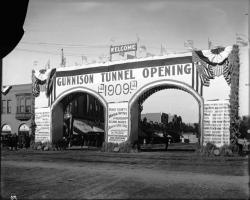
At its completion, the 5.8-mile Gunnison Tunnel under western Colorado's Vernal Mesa was the longest irrigation tunnel in America. It carried water from the Gunnison River to the Uncompahgre Valley to irrigate 146,000 acres of cropland.
Work on the 30,582-foot tunnel was first performed manually. Adverse geological conditions provided great challenge for this pioneering project. The drilling crews had to deal with clay, sand, shale, and a badly fractured fault zone.
YearAdded:
Image Credit: Public Domain; Produced prior to 1/1/1923Image Caption: Gunnison TunnelEra_date_from: 1909
1972
Innovations
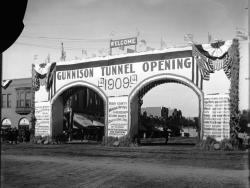
At its completion, the 5.8-mile Gunnison Tunnel under western Colorado's Vernal Mesa was the longest irrigation tunnel in America. It carried water from the Gunnison River to the Uncompahgre Valley to irrigate 146,000 acres of cropland.
Work on the 30,582-foot tunnel was first performed…
Read More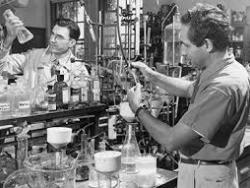
University of Wisconsin-Madison biochemist Karl Paul Link and his lab isolated an anticoagulant compound from spoiled sweet clover hay in 1939, after a Wisconsin farmer's cattle began hemorrhaging from the moldy feed. Their research led to warfarin, marketed first as a rat poison in 1948 and…
Read More