

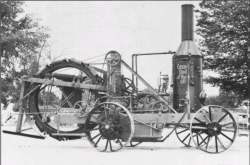
During the post-Civil War era, efforts to cultivate the land for higher crop yields resulted in the digging of thousands of miles of ditches to improve land drainage. Accurately graded ditches were needed for open drainage, pipeline trenches and placement of underground agricultural drainage tile. Teams of skilled workers laid out the direction and gradient of a ditch and dug it out with pick and shovel. The Black Swamp area, where Lake Erie drains into northwest Ohio and southeast Michigan, was the center of much of the U.S. ditching activity.
1988
YearAdded:
Image Caption: Buckeye Steam Traction DitcherEra_date_from: 1902
1988
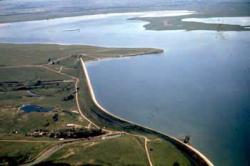
Belle Fourche, meaning "Beautiful Forks" in French, refers to the confluence of the Redwater and Belle Fourche Rivers. The gold rush to the Black Hills in 1876 brought many people to the area, but agriculture and livestock soon became the principal industries. Farmers and civic leaders recognized the need for a reliable source of irrigation water in this semi-arid region and petitioned the Federal government for funds to build an irrigation and flood control system.
YearAdded:
Image Credit: Public Domain (United States Bureau of Reclamation)Image Caption: An aerial view of the Belle Fourche DamEra_date_from: 1911
1988
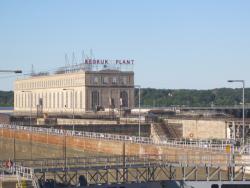
Spearheaded by Hugh Cooper, the Keokuk Dam & Power Plant served as a prototype for many future power plants. The project harnessed the hydropower of the Mississippi River, between Keokuk, Iowa and Hamilton, Illinois.
The crest of the dam is nearly a mile long. The dam structure features 119 arch spans between six-foot-thick piers and a 110-foot-wide pneumatic lock. Combined with the lock, the dam reduced travel time for steamboats by nearly two hours.
YearAdded:
Image Credit: Courtesy Flickr/Michael R. Allen (CC BY 2.0)Image Caption: Mississippi River Lock and Dam number 19Era_date_from: 1913
1988
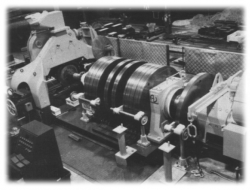
This inertia dynamometer is used to test railroad wheels under controlled conditions that can greatly exceed normal service. It is the first and only railroad dynamometer to test track wheels using vertical and lateral loads, as well as thermal braking loads, at the wheel rim. It can also test railway car and locomotive axles.
YearAdded:
Image Caption: AAR Railroad-wheel DynamometerEra_date_from: 1955
1988
Innovations