

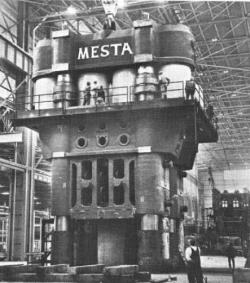
This 50,000-ton die-forging press is among the largest fabrication tools in the world. It was designed and built for the U.S. Air Force by the Mesta Machine Company of Pittsburgh, following the discovery of a 30,000-ton press used by the Germans in World War II (later acquired by the Soviet Union). By 1950, a Heavy Press Program was organized to establish a self-sustaining industrial base for a press capable of producing large forgings and extrusions for the United States. The 50,000-ton Mesta press was one of the first built under this program between 1952 and 1955.
OH
YearAdded:
Image Caption: The true enormity of the ALCOA 50,000-ton Hydraulic Forging Press can be fully appreciated when put into comparison of the average-sized person (lower right and on the platform).Era_date_from: 1954
1981
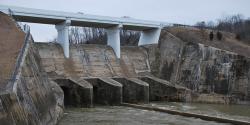
The Miami Conservancy District flood control project was the direct result of the disastrous flood of 1913, when waters from the Miami, Stillwater, and Mad rivers flooded Dayton and surrounding communities in the Miami Valley. More than 400 lives were lost and property damage exceeded $100 million. When Dayton flooded, great fires raged, adding to the devastation. Many believed that the area would never recover.
YearAdded:
Image Credit: Courtesy Flickr/bobosh_t (CC BY-SA 2.0)Image Caption: The Taylorsville Dam, one of the five dry damns to come out of the Miami Conservancy DistrictEra_date_from: 19221972
- Concrete Conduit
- Dry Dam
- Earth-Core
- Flood Control
- Flood Prevention Committee
- Great Depression
- Levee
- Mad River
- Miami Conservancy District
- Miami River
- Retardation Basin
- Stillwater River
- 1920-1929
- 1922
- 1972
- 45424
- ASCE
- Great Dayton Flood
- OH
- USA
- Water Supply & Control
- Civil
- Flood Prevention Committee
- Morgan, Arthur Ernest
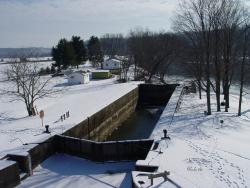
Most of the locks were 184 feet long and 36 feet wide, able to handle boats up to 160 feet long. The sandstone locks (along with wood miter gates, rock-filled timber-crib dams and bypass canals with guard gates) created a slackwater navigation system stretching over 90 miles.
YearAdded:
Image Credit: Courtesy Flickr/gb_packards (CC BY-ND 2.0)Image Caption: Muskingum River LockEra_date_from: 1837
2000
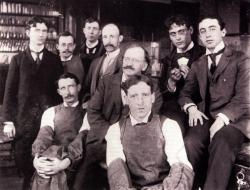
In his laboratory at Western Reserve University (Now Case Western Reserve University), Edward W. Morley carried out his research on the atomic weight of oxygen that provided a new standard to the science of chemistry. The accuracy of his analyses has never been superseded by chemical means. His great work, published in 1895, also gave important insight into the atomic theory of matter.
He observed, after carefully analysis of the volume proportions in which hydrogen and oxygen unite, that the atomic weight of oxygen was 15.879.
The plaque commemorating the event reads:
YearAdded:
Image Credit: Courtesy ACSImage Caption: Morley with students and instructors, ca. 1893.
1995
Innovations