

ACS

Term Image
Commercial Process for Producing Calcium Carbide and Acetylene
Society: ACSMain Category: ChemicalSub Category: Industrial AdvancesEra: 1890-1899DateCreated: 1898Spray Cotton MillsEdenState: NCCountry: USAWebsite: https://www.acs.org/content/acs/en/education/whatischemistry/landmarks/calciumcarbideacetylene.html, https://www.acs.org/content/dam/acsorg/education/whatischemistry/landmarks/calciumcarbideacetylene/commericialization-of-calcium-carbide-and-acetylene-commemorative-booklet.pdfCreator: Willson, Thomas L.

In his search for a more economical way to make aluminum, Canadian inventor Thomas Leopold Willson accidentally discovered the first commercially viable process for making calcium carbide, which is used for production of acetylene gas, at a location in North Carolina. This chance discovery produced a series of products, from improved lighting in remote locations to the synthesis of a host of organic substances.

The plaque commemorating the event reads:
YearAdded:
1998
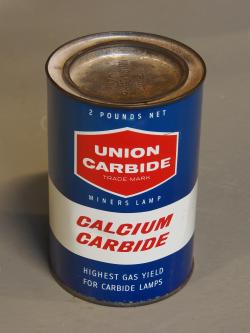
Image Caption: Photographed at the Den Hartogh Ford museum. Highest gas yield for carbide lamps. Sold by Union Carbide corporation, which was formed in 1898 to consolidate the interests of the Electrogas Company.
Discovery of Helium in Natural Gas
Society: ACSMain Category: ChemicalSub Category: Industrial AdvancesThe University of KansasLawrenceState: KSZip: 66045Country: USAWebsite: https://www.acs.org/content/acs/en/education/whatischemistry/landmarks/heliumnaturalgas.html, https://www.acs.org/content/dam/acsorg/education/whatischemistry/landmarks/heliumnaturalgas/discovery-of-helium-in-natural-gas-historical-resource.pdfCreator: Cady, Hamilton P., McFarland, David F.

Working in Bailey Hall on December 7, 1905, Hamilton P. Cady and David F. McFarland discovered significant amounts of helium in a natural gas sample from Dexter, Kansas. Cady and McFarland subsequently analyzed more than 40 other gas samples, showing that helium, previously thought to be rare on Earth but abundant in the Sun, was available in plentiful quantities from the Great Plains of the United States. Helium-filled blimps were vital to the United States in World War II, and helium is still considered a national strategic reserve material.


YearAdded:
2000
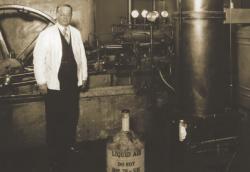
Image Credit: Courtesy ACSImage Caption: Hamilton P. Cady with the liquid air machine in Bailey Hall.
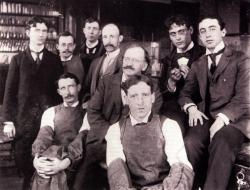
Morley with students and instructors, ca. 1893.
Society: ACSMain Category: ChemicalSub Category: Frontiers of KnowledgeDateCreated: 1895Case Western Reserve UniversityClevelandState: OHZip: 44106Country: USAWebsite: https://www.acs.org/content/acs/en/education/whatischemistry/landmarks/atomicweightofoxygen.htmlCreator: Morley, Edward W.

In his laboratory at Western Reserve University (Now Case Western Reserve University), Edward W. Morley carried out his research on the atomic weight of oxygen that provided a new standard to the science of chemistry. The accuracy of his analyses has never been superseded by chemical means. His great work, published in 1895, also gave important insight into the atomic theory of matter.

He observed, after carefully analysis of the volume proportions in which hydrogen and oxygen unite, that the atomic weight of oxygen was 15.879.

The plaque commemorating the event reads:
YearAdded:
1995
Image Credit: Courtesy ACSImage Caption: Morley with students and instructors, ca. 1893.
C.V. Raman and the Raman Effect
Society: ACSMain Category: ChemicalSub Category: Frontiers of KnowledgeEra: 1920-1929DateCreated: 1928Indian Association for the Cultivation of ScienceCalcuttaCountry: IndiaWebsite: https://www.acs.org/content/acs/en/education/whatischemistry/landmarks/ramaneffect.html, https://www.acs.org/content/dam/acsorg/education/whatischemistry/landmarks/ramaneffect/the-raman-effect-commemorative-booklet.pdfCreator: Raman, C.V.

"I propose this evening to speak to you on a new kind of radiation or light emission from atoms and molecules." With these prophetic words, Professor C. V. Raman of Calcutta University began his lecture to the South Indian Science Association in Bangalore on March 16, 1928. Raman proceeded to describe a discovery that resulted from a deceptively simple experiment. Conducted far from the great centers of scientific research in the Western world, the results would capture the attention of scientists around the world and bring many accolades, including the Nobel Prize, to their discoverer.

YearAdded:
1998
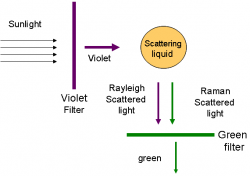
Image Credit: Courtesy Wikicommons/Pavlina2.0 (CC BY 3.0)vImage Caption: Raman Effect
Subscribe to ACS

We hope you enjoyed this essay.

Please support America's only magazine of the history of engineering and innovation, and the volunteers that sustain it with a donation to Invention & Technology.

Donate

Stay informed - subscribe to our newsletter.
The subscriber's email address.