
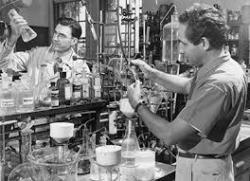
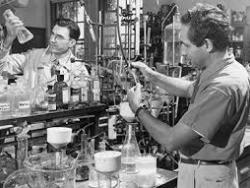
University of Wisconsin-Madison biochemist Karl Paul Link and his lab isolated an anticoagulant compound from spoiled sweet clover hay in 1939, after a Wisconsin farmer's cattle began hemorrhaging from the moldy feed. Their research led to warfarin, marketed first as a rat poison in 1948 and later approved as the blood-thinning drug warfarin sodium (Coumadin) in 1954. It remains one of the world's most widely prescribed anticoagulants.
1954
YearAdded:
Image Credit: The University of Wisconsin Collection, The American Chemical SocietyImage Caption: Mark A. Stahmann (left) and Karl Paul Link discovered dicumarol, a powerful anticoagulant. They are shown in 1940 in a UW-Madison biochemistry laboratory.2022
Courtesy of The University of Wisconsin Collection
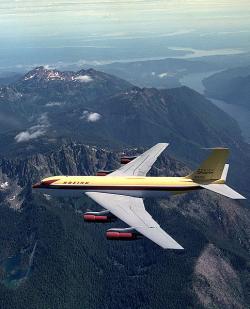
The 367-80 is the prototype for most jet transports. Its success was due largely to its mechanical systems, including turbine engines with thrust reversers and noise suppressors, redundant hydraulic control systems, and an improved cabin-pressurization system. Honeycomb flap panels were introduced, along with a strong, lightweight structural design that controlled fatigue cracking. These led to several innovations in aircraft tooling and manufacturing techniques.
The Dash-80 was the first commercial airliner economical enough to take the US airline industry off subsidy.
YearAdded:
Image Credit: Courtesy Wikipedia/Boeing Dreamscape (CC BY 2.0)Image Caption: Prototype of the Boeing 707 and most jet transport systems, the Boeing 367-80 established economic feasibility of commercial air travel.Era_date_from: 1954
1994
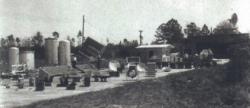
GainesvilleState: FLCountry: USAWebsite: http://www.asme.org/about-asme/history/landmarks/topics-m-z/research-and-development/-223-solar-energy-and-energy-conversion-laboratory, https://www.asme.org/getmedia/6ab985e7-a7b5-4c91-b4d7-8c32af04334c/223-Solar-Energy-and-Energy-Conversion-Laboratory.aspxCreator: Farber, Erich
This highly diverse facility has pioneered the development of solar energy applications worldwide. The Solar Energy and Energy Conversion Laboratory (SEECL) was unique in developing practical solar energy devices based on established principles of thermodynamics, heat transfer, and fluid mechanics long before solar energy was considered a serious energy alternative.
YearAdded:
Image Credit: Courtesy ASMEImage Caption: The SEECL was originally located at the Gianesville Regional Airport. Early experimental devices stood on the pad near the WW II bunker (early 1950s).Era_date_from: 1954
2003
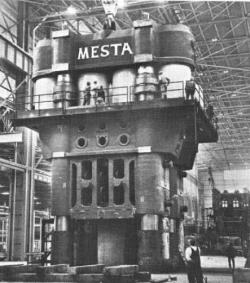
This 50,000-ton die-forging press is among the largest fabrication tools in the world. It was designed and built for the U.S. Air Force by the Mesta Machine Company of Pittsburgh, following the discovery of a 30,000-ton press used by the Germans in World War II (later acquired by the Soviet Union). By 1950, a Heavy Press Program was organized to establish a self-sustaining industrial base for a press capable of producing large forgings and extrusions for the United States. The 50,000-ton Mesta press was one of the first built under this program between 1952 and 1955.
YearAdded:
Image Caption: The true enormity of the ALCOA 50,000-ton Hydraulic Forging Press can be fully appreciated when put into comparison of the average-sized person (lower right and on the platform).Era_date_from: 1954
1981
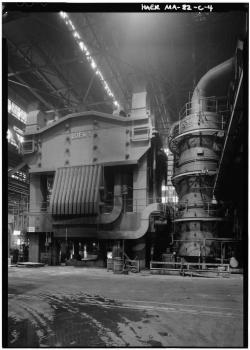
This hydraulic closed-die press, among the largest fabrication tools in the world, has had a profound influence in America's leading role in commercial aircraft, military aircraft, and space technology. As part of the same Heavy Press Program that created the Mesta press, the Wyman-Gordon press was designed by the Loewy Construction Company and began operating in October 1955. Among its contributions was the development of the new jetliner Boeing 747 in the 1960s.
YearAdded:
Image Credit: Courtesy ASMEImage Caption: Wyman-Gordon 50,000-ton Hydraulic Forging PressEra_date_from: 1954
1983
Innovations
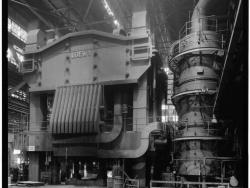
This hydraulic closed-die press, among the largest fabrication tools in the world, has had a profound influence in America's leading role in commercial aircraft, military aircraft, and space technology. As part of the same Heavy Press Program that created the Mesta press, the Wyman-Gordon press…
Read More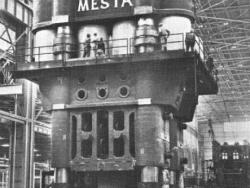
This 50,000-ton die-forging press is among the largest fabrication tools in the world. It was designed and built for the U.S. Air Force by the Mesta Machine Company of Pittsburgh, following the discovery of a 30,000-ton press used by the Germans in World War II (later acquired by the Soviet…
Read More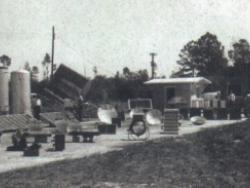
This highly diverse facility has pioneered the development of solar energy applications worldwide. The Solar Energy and Energy Conversion Laboratory (SEECL) was unique in developing practical solar energy devices based on established principles of thermodynamics, heat transfer, and fluid…
Read More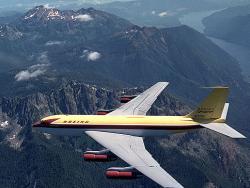
The 367-80 is the prototype for most jet transports. Its success was due largely to its mechanical systems, including turbine engines with thrust reversers and noise suppressors, redundant hydraulic control systems, and an improved cabin-pressurization system. Honeycomb flap panels were introduced… Read More
University of Wisconsin-Madison biochemist Karl Paul Link and his lab isolated an anticoagulant compound from spoiled sweet clover hay in 1939, after a Wisconsin farmer's cattle began hemorrhaging from the moldy feed. Their research led to warfarin, marketed first as a rat poison in 1948 and…
Read More