
CA

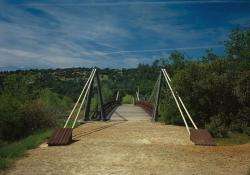
Bidwell Bar Suspension Bridge
Society: ASCEMain Category: CivilSub Category: BridgesEra: 1850-1859DateCreated: 1856Feather RiverOrovilleState: CAZip: 95966Country: USAWebsite: http://www.asce.org/project/Bidwell-Bar-Suspension-Bridge/Creator: Jones and Murray

Soon after gold was discovered at Sutter's Mill near Sacramento in 1848, General John Bidwell found gold near the Middle Fork of the Feather River. His discovery brought hordes of miners to the scene and Bidwell Bar was born. The Bidwell Bar Suspension Bridge over the Feather River was one of several suspension bridges built in the region in the 1850s, and is the only one that remains.
 

YearAdded:
1967
Image Credit: Public Domain (National Park Service)Image Caption: The original Bidwell Bar Suspension Bridge (1856), crossing over the Feather RiverEra_date_from: 1856
Society: ASMEMain Category: MechanicalSub Category: Air and Space TransportationEra: 1950-1959DateCreated: 1957Gillespie Fields AirportEl CajonState: CAZip: 92020Country: USAWebsite: http://www.asme.org/about-asme/history/landmarks/topics-a-l/air-and-space-transportation/-102-atlas-launch-vehicle-%281957%29Creator: Convair Division of General Dynamics, U.S. Air Force
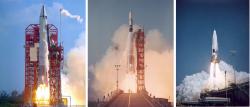
The Atlas E-2 Space Booster, or launch vehicle, is a modified intercontinental ballistic missile developed by the Convair Division of General Dynamics and the U.S. Air Force. The basic concept of the Atlas system was proven in its first flight on June 11, 1957, followed over the years by the launching more than five hundred vehicles including the Pioneer, Ranger, Mariner, and Surveyor. Many payloads were sent into orbit as detachable sections of Atlas missiles.
YearAdded:
1985
Image Credit: All 3 images are Public DomainImage Caption: A compilation of three successful launches vehicles in action. On the left is the Atlas-Centaur, the center is the Atlas-Agena, and the right is the SM-65A Atlas missile.Era_date_from: 1957
Arroyo Seco Parkway
Society: ASCEMain Category: CivilSub Category: Roads & RailsEra: 1940-1949DateCreated: 1940Pasadena to Los AngelesLos AngelosState: CACountry: USAWebsite: http://www.asce.org/project/arroyo-seco-parkway/Creator: Allen, T.D.

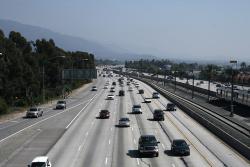
With its landscaped embankments, limited access, and depressed roadway, Arroyo Seco Parkway (now known as the Pasadena Freeway) became the prototype of the Los Angeles freeway system. Motorists enjoy a scenic drive featuring landscaped embankments lush with native chaparral. The curving alignment traverses a chain of small parks shaded by sycamores and eucalyptus and exposed views of the snow-capped San Gabriel Mountains.

YearAdded:
1999
Image Credit: Courtesy Flickr/prayitno (CC BY 2.0) Image Caption: Arroyo Seco Parkway (also called the Pasadena Freeway) as it is seen today by thousands of commutersEra_date_from: 1940
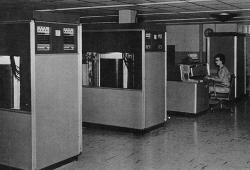
IBM 350 RAMAC Disk File
Society: ASMEMain Category: MechanicalSub Category: Communications and Data ProcessingEra: 1950-1959DateCreated: 1956IBM Building 12San JoseState: CAZip: 95193Country: USAWebsite: http://www.asme.org/about-asme/history/landmarks/topics-a-l/communications-and-data-processing/-90-ibm-350-ramac-disk-file-%281956%29, http://www.magneticdiskheritagecenter.org/MDHC/RAMACBrochure.pdfCreator: IBM

The IBM 350 disk drive storage development led to the breakthrough of on-line computer systems by providing the first storage device with random access to large volumes of data. Since its introduction on September 4, 1956, it has become the primary computer bulk-storage medium, displacing punched cards and magnetic tapes and making possible the use of the computer in such areas as airline reservations, automated banking, medical diagnosis, and space flights.

YearAdded:
1984
Image Credit: Public Domain (US Army)Image Caption: IBM 350 RAMAC Disk FileEra_date_from: 1956
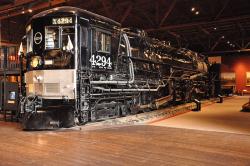
Southern Pacific #4294 Cab-in-Front Steam Locomotive
Society: ASMEMain Category: MechanicalSub Category: Rail TransportationEra: 1940-1949DateCreated: 1944California State Railroad MuseumSacramentoState: CAZip: 95814Country: USAWebsite: http://www.asme.org/about-asme/history/landmarks/topics-m-z/rail-transportation---1/-62-southern-pacific--4294-cab-in-front-steam-loco, https://www.asme.org/getmedia/4527cb4e-6984-4c88-b513-c3daf7dd5679/62-Southern-Pacific-4294-Cab-in-Front-Steam-Loco.aspxCreator: Baldwin Locomotive Works, Southern Pacific Railroad

The articulated wheel-base steam locomotive represents the final phase of steam locomotive development in size and power. The cab-in-front feature was widely used by the Southern Pacific Railroad beginning in 1909 to alleviate smoke and heat problems for locomotive personnel en route through tunnels and snow sheds. This locomotive, built by the Baldwin Locomotive Works, operated between 1944 and 1956 before being displaced by a diesel-electric locomotive.

YearAdded:
1981
Image Credit: Courtesy Wikipedia/Neil916 (CC BY-SA 3.0)Image Caption: Southern Pacific #4294 Cab-in-Front Steam LocomotiveEra_date_from: 1944
First Successful Commercialization of Radiation Chemistry
Society: ACSMain Category: ChemicalSub Category: New ProductsEra: 1950-1959DateCreated: 1957TE Connectivity Ltd.FremontState: CACountry: USAWebsite: https://www.acs.org/content/acs/en/education/whatischemistry/landmarks/radiationchemistry.html, https://www.acs.org/content/dam/acsorg/education/whatischemistry/landmarks/radiationchemistry/commercialization-of-radiation-chemistry-historical-resource.pdfCreator: Cook, Paul

Founded in 1957, Raychem Corporation was the first company to successfully apply the new science of radiation chemistry to commercial use. This accomplishment led to the creation of tough new materials and high-performance products such as irradiated polyethylene insulated wire and heat-shrinkable tubing through the crosslinking of polymeric materials.

YearAdded:
1997
Image Caption: First Successful Commercialization of Radiation Chemistry
Subscribe to CA

We hope you enjoyed this essay.

Please support America's only magazine of the history of engineering and innovation, and the volunteers that sustain it with a donation to Invention & Technology.

Donate

Stay informed - subscribe to our newsletter.
The subscriber's email address.