
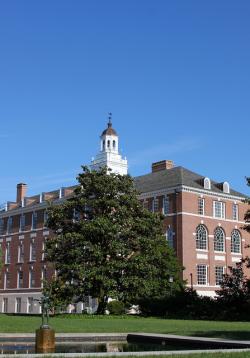
Gilman Hall, built in 1916-1917, accommodated a growing College of Chemistry by providing expanded research and teaching facilities for faculty and students specializing in physical, inorganic and nuclear chemistry. Work performed at Gilman Hall helped advance the fields of chemical thermodynamics and molecular structure, and has resulted in multiple Nobel Prizes. The Hall is most famous for the work of Glenn T. Seaborg and his coworkers, which included the successful identification and production the element Plutonium. Seaborg received the Nobel Prize in 1951 for his accomplishments.
CA
YearAdded:
Image Credit: Courtesy Flickr/Waqas Bhatti (CC BY-SA 2.0)Image Caption: Gilman HallEra_date_from: 1917
1997
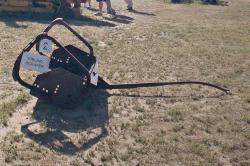
The Fresno scraper established the basis for the modern earthmoving scraper, being able to scrape and move a load of soil, then discharge it at a controlled depth. It quadrupled the productivity of manual labor, replacing hand shoveling of earth into horse carts.
YearAdded:
Image Credit: Courtesy Flickr/Alisha Vargas (CC BY 2.0)Image Caption: Fresno ScraperEra_date_from: 1883
1991
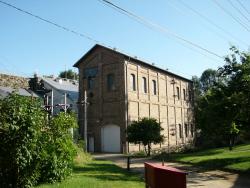
The historic Folsom Power House #1 marks one of the first successful uses of hydroelectric power in the world and the first successful transmission of power long distance (twenty-two miles to Sacramento). The old Folsom Power House still shelters the machinery generated to drive streetcars and illuminate the city of Sacramento.
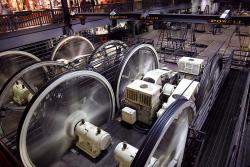
The F&CH Cable Railway, which opened in 1887, was designed and built by civil engineer Howard C. Holmes (1852-1921). The line is an amalgamation of the Powell Street Railway and the Park and Cliff House Railway. It was one of the most complicated cable-car systems to run from a single station and had been under construction two years prior to its opening.
Andrew Hallidie, a wire rope manufacturer, devised the first operating cable car in the United States in 1873, which ran on Clay Street hill.
YearAdded:
Image Credit: Courtesy Wikipedia/Caroline Culler (CC BY-SA 3.0)Image Caption: Ferries & Cliffhouse Cable Railway Power HouseEra_date_from: 1887
1973
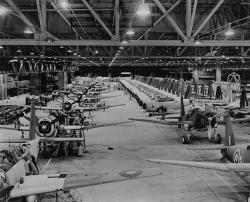
Established in 1929, and owned by several different aviation companies through its history, the Downey site was the design, test, and production site for various airplanes and spacecraft that defined American aerospace accomplishments in the 20th century.
YearAdded:
Image Caption: Production of the Vultee Vengeance bombers for the Royal Air Force at Downey, California, 1942Era_date_from: 1929
2010
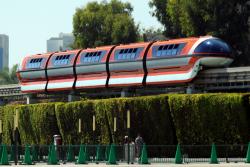
Disney engineers designed this monorail system based on the system developed by Axel Wenner-Gren of the Alweg Company in Cologne, West Germany. Wenner-Gren ran his experimental monorail in 1952 on a level track, and when adopted by Disney in 1959, it was designed to simulate the terrain typical of urban transit. Opening in 1959, the system has been in continuous operation as a passenger service carrying an average of 340,000 passengers a year and logging 10,000 miles. The original trains were replaced in 1969 and a new fleet introduced in 1987 to upgrade the existing chassis.
YearAdded:
Image Credit: Courtesy Flickr/prayitno (CC BY 2.0)Image Caption: Disneyland Monorail SystemEra_date_from: 1959
1986
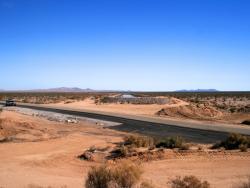
Parker DamState: CACountry: USAWebsite: http://www.asce.org/Project/Colorado-River-Aqueduct/Creator: Weymouth, Frank E.
Stretching 242 miles from the Colorado River on the California-Arizona border to its final holding reservoir near Riverside, California, the Colorado River Aqueduct consists of more than 90 miles of tunnels, nearly 55 miles of cut-and-cover conduit, almost 30 miles of siphons, and five pumping stations. Supplying approximately 1.2 million acre-feet of water a year - more than a billion gallons a day - it helped make possible the phenomenal growth of Los Angeles, San Diego, and surrounding Southern California areas in the second half of the 20th century.
YearAdded:
Image Credit: Courtesy Flickr/Chuck Coker (CC BY-ND 2.0)Image Caption: Colorado River Aqueduct sinks into a tunnel underneath California State Highway 62Era_date_from: 1933
1994
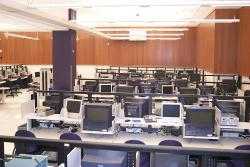
"SPICE (Simulation Program with Integrated Circuit Emphasis) was created at UC Berkeley as a class project in 1969-1970. It evolved to become the worldwide standard integrated circuit simulator. SPICE has been used to train many students in the intricacies of circuit simulation.
YearAdded:
Image Credit: Courtesy UCLAImage Caption: Birthplace of the SPICE Circuit Simulation ProgramEra_date_from: 1969
2011
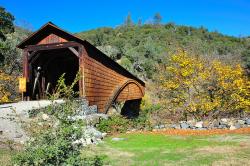
A product of the Northern California Gold Rush, the Bridgeport Covered Bridge is believed to be the longest, single-span, wooden covered bridge in the United States. Crossing the south fork of the Yuba River at a span of 233 feet, the bridge was built by the Virginia City Turnpike Company as part of a 14-mile toll road authorized by the California state legislature. The toll road was an essential link connecting Virginia City, Nevada, and the silver-producing Comstock Lode with the centers of California commerce.
YearAdded:
Image Credit: Courtesy Flickr/Rick Cooper (CC BY 2.0)Image Caption: The Bridgeport Covered Bridge, one of the longest covered bridges in the nationEra_date_from: 1862
1970
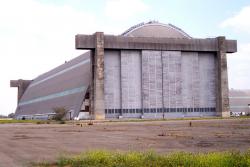
All building materials were made fire-resistant to protect against incendiary bombing. Treatment involved a vacuum process of salt impregnation. During construction, high winds caused a partial collapse of some members. The ruined materials were piled for incineration, but would not burn; so the rubble was buried on site. Years later, a farmer leasing ground on the site plowed up some of the materials. They were reported to still be in good condition.
YearAdded:
Image Credit: Courtesy Wikipedia/Lordkinbote (CC BY-SA 2.0)Image Caption: Hangar No. 2Era_date_from: 1943
1993
Innovations