
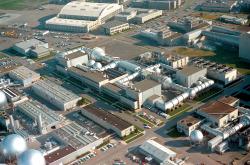
This wind tunnel complex was developed by the National Advisory Committee for Aeronautics (NASA's predecessor) to serve the emerging need for supersonic research and development following World War II. The three-testing-section configuration covers Mach number .03-3.5 and utilizes a single common drive and two compressors.
CA
YearAdded:
Image Credit: Public Domain (NASA)Image Caption: NASA Ames Unitary Plan Wind TunnelEra_date_from: 1956
1996
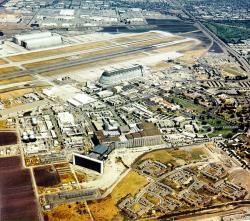
Established in 1939 by the National Advisory Committee for Aeronautics (NACA), and named after NACA’s first chairman, Joseph S. Ames, the center has been at the forefront of American, and worldwide, aeronautics research.
YearAdded:
Image Credit: Public Domain (NASA)Image Caption: NASA Ames Research CenterEra_date_from: 1939
2009
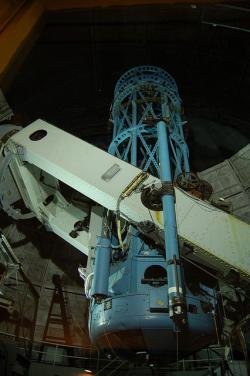
The increased light-grasp of this telescope made possible many notable advances in structural cosmology between 1924 and 1930, which have revised our ideas about the universe. One of these advances was that spiral nebulae are galactic units like our own; another was the idea of an expanding universe. George Ellery Hale began planning this project in 1906; Francis G. Pease was the chief designer and mechanical engineer. The telescope's mirror support and the use of mercury flotation to reduce the friction are among its outstanding mechanical engineering features.
YearAdded:
Image Credit: Courtesy Flickr/Bruce Irving (CC BY 2.0)Image Caption: Mount Wilson Observatory, 100-inch Hooker TelescopeEra_date_from: 1918
1981
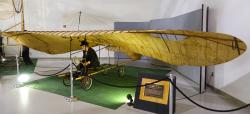
The glider was the first heavier-than-air human-carrying aircraft to achieve controlled piloted flight. On his first successful flight, August 28, 1883, John Montgomery soared at about 600 feet. The Montgomery glider's success demonstrated aerodynamic principles and designs fundamental to the modern aircraft.
YearAdded:
Image Caption: Montgomery Glider replica, International Historic Mechanical Engineering Landmark, 1996, original glider by John Joseph Montgomery, 1883 - Hiller Aviation Museum - San Carlos, CaliforniaEra_date_from: 1883
1996
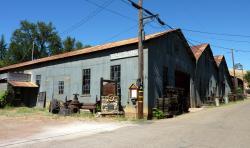
This is one of the earliest US foundry-machine shops remaining in operation and one of the few water powered. It was founded by Samuel N. Knight (1838-1913) to manufacture machinery for the gold mines of the Mother Lode region. Knight was one of several inventors experimenting with impulse turbines to exploit the area's abundant high-head water power for driving hoists, ore stamps, and other mining machinery.
YearAdded:
Image Credit: Courtesy Wikipedia/Bobak Ha'Eri (CC BY 3.0)Image Caption: Knight Foundry and Machine ShopEra_date_from: 1873
1995
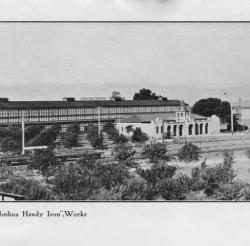
This ironworks exemplified the adaptability required for industrial survival in a dynamic technical environment. It was a major western producer of mechanical equipment used in mining (especially large hydraulic machines), ship propulsion, irrigation, power generation, optical telescope mounts, and nuclear research.
YearAdded:
Image Credit: Public DomainImage Caption: Joshua Hendy Iron WorksEra_date_from: 1906
1978

"At 10:30 p.m., 29 October 1969, the first ARPANET message was sent from this UCLA site to the Stanford Research Institute. Based on packet switching and dynamic resource allocation, the sharing of information digitally from this first node of ARPANET launched the Internet revolution."
(The plaque can be seen at the UCLA Henry Samueli School of Engineering and Applied Sciences, 405 Hilgard Ave., Los Angeles, California, U.S.A.)
The deployment of the ARPANET set in motion a train of developments that led to the Internet as we know it today.
YearAdded:
Image Credit: Courtesy Flickr/FastLizard4 (CC BY-SA 2.0)Image Caption: The original Interface Message Processor, a primitive router, and considered widely to be the beginning (or "birth") of the internetEra_date_from: 1969
2009
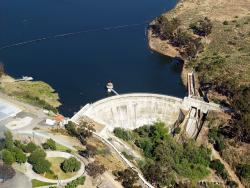
When completed in 1888 to a height of 90 feet, Sweetwater Dam was once the tallest masonry arch dam in the United States, and it led to many others of the same basic design. The original construction began in November 1886 under the direction of Frank E. Brown (civil engineer for Bear Valley Dam) with the rubble-masonry thin-arch design being 50 feet in height. Subsequently, the owner of the water system called upon civil engineer James D. Schuyler to continue and complete the project. Although the field of hydrology was very new and not fully understood at the time, Mr.
YearAdded:
Image Credit: Courtesy Flickr/Phil Konstantin (CC BY 2.0)Image Caption: Sweetwater DamEra_date_from: 1888
2005
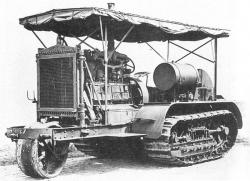
The first practical demonstration of this tractor took place in a peat field on Roberts Island on November 24, 1904, and was patented and in production by December of 1907. The existing machine represents the earliest gasoline-powered track-type tractors that were to help revolutionize agriculture, logging, construction, road building, and transportation around the world. Its design and development is credited to Benjamin Holt (1849-1920), president of the Holt Manufacturing Company of Stockton.
YearAdded:
Image Credit: Public Domain (Copyright Expired)Image Caption: The Holt 75 model gasoline-powered Caterpillar tractor used early in World War I as an artillery tractor. Later models were produced without the front "tiller wheel."Era_date_from: 1918
1981
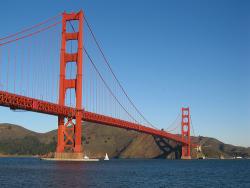
Put in service in 1937, this world-renowned bridge, conceived by Joseph Strauss and designed largely by Charles Ellis, was the longest single span (4,200 feet) in the world for a quarter century.
As with many civil engineering projects in their conceptual stages, naysayers scoffed at the Golden Gate Bridge. They said it would be technically unfeasible or too expensive to bridge the Golden Gate, a 1.7-mile-wide opening separating the Pacific Ocean from the San Francisco Bay. They said that the channel was too deep; the tides and winds too strong; the span too long.
YearAdded:
Image Credit: Courtesy Flickr/Salim Virji (CC BY-SA 2.0)Image Caption: Golden Gate BridgeEra_date_from: 1937
1984
Innovations