

The antihistamine Benadryl has provided temporary relief from allergy symptoms for millions of people since it was developed by George Rieveschl at a University of Cincinnati laboratory in the early 1940s and later approved by the U.S. Food and Drug Administration (FDA). Rieveschl was originally studying muscle relaxants when he discovered the compound diphenhydramine hydrochloride. He sold it under the name ‘Benadryl,’ among others.
USA

CincinnatiState: OHZip: 45267Country: USAWebsite: https://www.acs.org/education/whatischemistry/landmarks/benadryl.htmlCreator: Rieveschl, George
YearAdded:
Image Credit: George Rieveschl, Jr. Papers of The Lloyd Library & MuseumImage Caption: Rieveschl holding a Benadryl capsule, the medication that has provided allergy relief to millions worldwide.
2025

In the 1940s, researchers Irvine Page, Maurice Rapport, Arda Green and Betty Twarog made pioneering discoveries that transformed modern neuroscience. While investigating hypertension at Cleveland Clinic, Page, Rapport and Green helped identify and isolate serotonin (5-hydroxy-tryptamine). Twarog later demonstrated its presence in the mammalian brain, establishing serotonin as a neurotransmitter. Together, their breakthroughs opened the door to understanding serotonin’s essential roles in regulating mood, appetite, digestion, healing and numerous physiological processes.
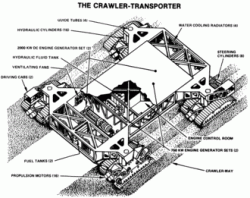
The crawler-transporters, formally known as the Missile Crawler Transporter Facilities, are a pair of tracked vehicles used to transport spacecraft from NASA's Vehicle Assembly Building (VAB) along the Crawlerway to Launch Complex 39. They were originally used to transport the Saturn IB and Saturn V rockets during the Apollo, Skylab and Apollo-Soyuz programs. They were then used to transport Space Shuttles from 1981 to 2011. The crawler-transporters carry vehicles on the mobile platform launchers used by NASA, and after each launch return to the pad to take the platform back to the VAB.
YearAdded:
1982
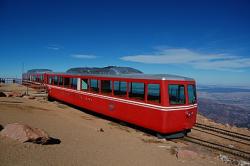
The Broadmoor Manitou and Pikes Peak Cog Railway (also known as the Pikes Peak Cog Railway) is a cog railway that climbs one of the most iconic mountains in the United States, Pikes Peak in Colorado. The base station is in Manitou Springs, near Colorado Springs.
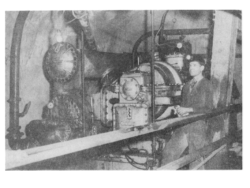
The Magma Copper Mine AC system designed by the Carrier Corporation was the first underground mechanical air conditioning system in North America. The initial installation of refrigerated cooling equipment in the Magma Mine at Superior, Arizona was necessary due to the increase in temperature lower into the mine. Below the 2000-foot level, the increase in rock temperature is approximately 1½ degrees F. per 100 feet of depth. The rock temperature on the 2000-foot level is 109°.
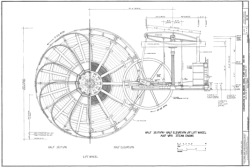
The Old Lock Pump House, whose first element was built in 1837, preserves a feature of the old canal, which relied on locks and pumps to move vessels over the low divide of the Delmarva Peninsula between Chesapeake Bay and Delaware Bay. Because there are no large rivers on the peninsula, water had to be pumped uphill to fill the upper canal and locks.
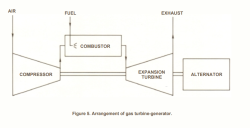
The Belle Isle gas turbine was installed in 1949 and was the first gas turbine built in the United States for the purpose of generating electric power. Its low cost and consistency aroused considerable interest in the electric utility industry, both here and abroad.
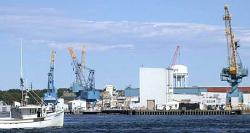
The Portsmouth Navy Yard is a United States Navy shipyard in Kittery on the southern boundary of Maine near the city of Portsmouth, New Hampshire. Founded in 1800, PNS is U.S. Navy's oldest continuously operating shipyard. Today, most of its work concerns the overhaul, repair, and modernization of submarines. he Portsmouth Naval Shipyard was established on June 12, 1800, during the administration of President John Adams.
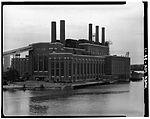
The Edger station was the first steam electric plant produced that could tolerate over 1000 psi of pressure. Initially conceived by Mr. Irving Edwin Moultrop, then Assistant Superintendent, Construction Bureau of the Edison Electric Illuminating Company of Boston. He guided his company and the electric utility industry on a major step forward into the higher-pressure range of 1,200 psi steam.
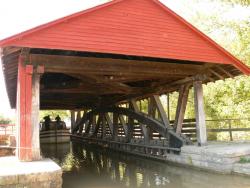
Duck Creek Aqueduct is a rare surviving example of a covered timber aqueduct. It was one of several similar structures on the Whitewater Canal, which operated between the Whitewater Valley and the Ohio River from 1839 to 1865. After being displaced by the railroad, the canal supplied hydraulic power for the industrial districts at Metamora and Brookville.
Innovations
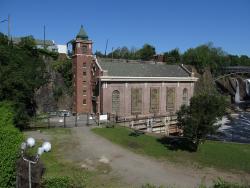
Visionary Alexander Hamilton, the United States' first Secretary of the Treasury, visited the Great Falls of the Passaic River with George Washington in 1778. The 77-foot-high, 280-foot-wide waterfall inspired his dream of abundant, inexpensive energy as the means for economic independence from…
Read More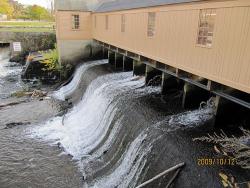
Much of the sophisticated system of canals, dams, gates, and tunnels built to manage water power in 19th-century Lowell is preserved today as the basis of the Lowell National Historical Park and the Lowell Heritage State Park. Pictured above is the Boott Penstock, an early channel adjacent to…
Read More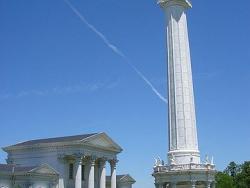
In the 18th century, French architect Claude-Nichols Ledoux was known for forging architectural beauty with industrial efficiency. One hundred years later his vision was given new life through the design of the Louisville Water Company Pumping Station. Inspired by Ledoux's Royal Salt Works at…
Read More
Most of the locks were 184 feet long and 36 feet wide, able to handle boats up to 160 feet long. The sandstone locks (along with wood miter gates, rock-filled timber-crib dams and bypass canals with guard gates) created a slackwater navigation system stretching over 90 miles.
…
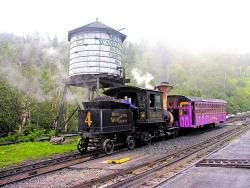
People thought inventor Walter Aiken was crazy when he proposed a railway to the top of Mt. Washington. Aiken built a model of the roadbed and track with a cog rail system, but entrepreneur Sylvester Marsh is credited for launching the Cog Railway and bringing Aiken's ideas to fruition.
… Read More
In the mid-1800s Virginia City was America's greatest producer of high-grade silver and gold ore. When mining activities began, natural springs provided water to the camps. As the population grew, the Virginia and Gold Hill Water Company was formed to address the need for more water. The company…
Read MoreThis machine, which began operation on December 15, 1891, for the New York Edison Illuminating Company, represents the beginning of large-scale electric power generation in the United States. The generator was designed by chief engineer John Van Vleck, David Joy (known in England for his valve…
Read More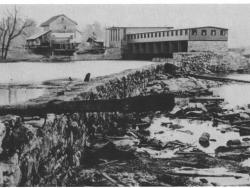
This run-of-the-river plant is a typical example of late nineteenth-century small-scale (750 kilowatt) low-head hydroelectric power technology. The Fries Manufacturing and Power Company began operating the Idol's Station on April 18, 1898, making it the first commercial hydroelectric plant in…
Read More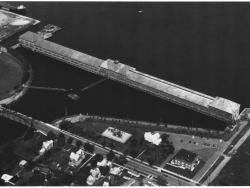
This low-head operating plant is representative of nineteenth-century hydropower-plant practice using many small turbines in contrast to twentieth-century use of few large turbines and generators. Its 40,000 horsepower capacity made it the largest in the country using turbines of American design…
Read More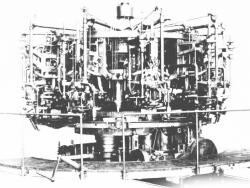
Only since 1912 have glass jars and bottles been in cheap and plentiful supply for pharmaceuticals, household products, food and beverages, and an endless variety of uses. The bottle-making machine introduced the safety, standardization, quality, and convenience of glass containers. Not only did…
Read More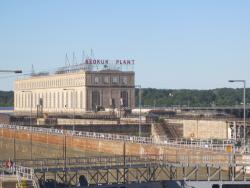
Spearheaded by Hugh Cooper, the Keokuk Dam & Power Plant served as a prototype for many future power plants. The project harnessed the hydropower of the Mississippi River, between Keokuk, Iowa and Hamilton, Illinois.
The crest of the dam is nearly a mile long. The dam structure…
Read More
The 1.6-mile Holland Tunnel was the first underwater vehicular crossing of the Hudson River and the first tunnel specifically designed for automobiles and trucks. It dramatically reduced the time required to traverse the Hudson River, a trip previously possible only by ferry.
A major…
Read More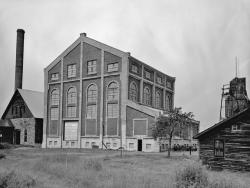
The largest mine hoist in the world, it serves the two incline skipways of Shaft No. 2, almost 9,300 feet long. The overhead winding drum has a diameter of 30 feet, of which the cylindrical center section is 10 feet long. The two 10-foot long end sections taper down to a 15-foot diameter. Wire…
Read More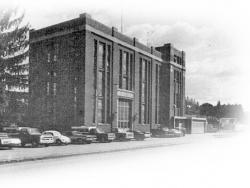
The Connecticut Light & Power Company pioneered the use of pumped storage in the United States at this hydroelectric station. First operated in 1929, the Rocky River Plant had two reversible pumps that somewhat resemble large hydroelectric turbines. This permitted significant improvements in…
Read More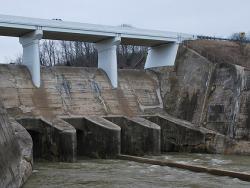
The Miami Conservancy District flood control project was the direct result of the disastrous flood of 1913, when waters from the Miami, Stillwater, and Mad rivers flooded Dayton and surrounding communities in the Miami Valley. More than 400 lives were lost and property damage exceeded $100…
Read More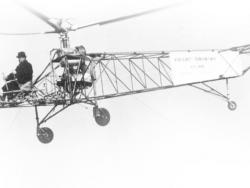
America's first practical helicopter, it pioneered the single main rotor concept that became the predominant helicopter configuration throughout the world. The principles that were developed and demonstrated by the VS-300 had direct application in the design of the early mass-production…
Read MoreThe Wildcat's innovative "Sto-Wing" mechanism developed on the XF4F-4 prototype by Leroy (Roy) Grumman (1895-1982), a founder of Grumman Aircraft Engineering Corporation, was crucial to the U. S. Navy's success during World War II.
The idea of a folding wing was not new: as early as 1920…
Read More
Maine's heavy snows led turnpike maintenance personnel to bring "left-handed" snow plows into prominence. By using left-handed and traditional right-handed plows in tandem, they were able to distribute snow more evenly - an important advance that has been emulated by many highway maintenance…
Read More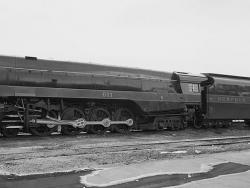
Developed for use in both the plains and mountains, this coal-fired passenger locomotive was among the most advanced in design, construction, and performance of any 4-8-4. Designed by Norfolk & Western engineers and built in the Norfolk & Western Roanoke shops, the 611 was specially…
Read More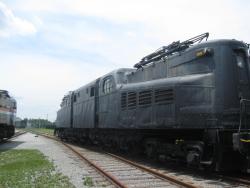
The 4,620-horsepower GG1 was primarily a passenger locomotive, routinely operating at over 100 miles per hour, but was used in freight service as well. Conceived by the Pennsylvania Railroad and built by the Baldwin Locomotive Works and General Electric Company, No. 4800 logged nearly 5 million…
Read More