
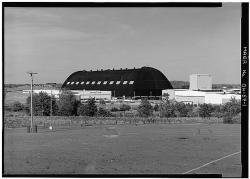
Wind dynamics were a major consideration in building such a huge structure. When winds blow against the building, they are deflected up over the roof, creating a partial vacuum that can draw the roof up with a force several times greater than the direct force of the wind. Wind tunnel testing on a model helped designers decide that a semi-parabolic shape would best resolve air current concerns.
Aerospace & Aviation
YearAdded:
Image Credit: Public Domain (National Park Service)Image Caption: Goodyear AirdockEra_date_from: 1929
1980
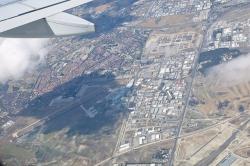
Getafe Airfield was the site of the world’s first successful rotorcraft flight, on January 17, 1923. Lieutenant Alejandro Gómez Spencer piloted a C.4 Autogiro designed and built by Juan de la Cierva, who tested a series of autogiros between 1920 and 1924 at the Getafe site. Cierva’s autogiros introduced important technologies and flight techniques that led to the development of helicopters and other rotary wing aircraft. Getafe Air Base, established in 1911, now houses several training and transport units of the Spanish Air Force, as well as two aerospace manufacturing plants.
YearAdded:
Image Credit: Courtesy Flickr/Jumbero (CC BY-SA 2.0)Image Caption: Getafe AirfieldEra_date_from: 1911
2011
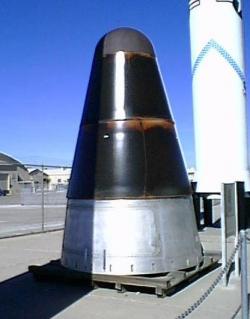
From 1956 to 1993, the GE Re-entry Systems facility was home to thousands of engineers and technicians who solved the problem of vehicles successfully reentering the Earth’s atmosphere. As described by aerospace pioneer Theodore Von Karman, “ Reentry… is perhaps the most difficult problem one can imagine.” Whether it was the first operational reentry vehicle for the Atlas ICBM, the recovery of the first man-made object from orbit, or the first probe to enter Jupiter’s atmosphere, some of the most significant milestones in aerospace were accomplished by those working in this facility.
YearAdded:
Image Credit: Public Domain (Author's Choice)Image Caption: GE Re-entry SystemsEra_date_from: 1956
2007
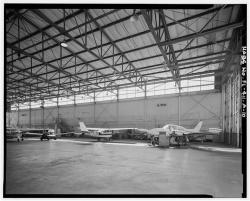
Established in 1935 as the Valparaiso Bombing and Gunnery Base, the base supported the U.S. Army Air Corps, the predecessor to the U.S. Air Force, as its primary facility for training new pilots in bombing and gunnery tactics. It also served as a test facility for aircraft, aircraft armament, air-delivered munitions and other aircraft systems. The base was renamed Eglin Field in 1937 in honor of Air Corps aviator Lt. Col. Frederick I. Eglin, who trained pilots during World War I, and who had recently died in an aircraft accident. After Congress created the U.S.
YearAdded:
Image Credit: Public Domain (National Park Service)Image Caption: Eglin Air Force BaseEra_date_from: 1935
2009
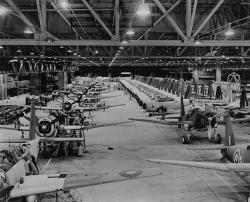
Established in 1929, and owned by several different aviation companies through its history, the Downey site was the design, test, and production site for various airplanes and spacecraft that defined American aerospace accomplishments in the 20th century.
YearAdded:
Image Caption: Production of the Vultee Vengeance bombers for the Royal Air Force at Downey, California, 1942Era_date_from: 1929
2010
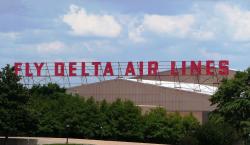
Delta Air Lines’ historic buildings consist of two aircraft hangers and several office buildings at the Delta World Headquarters site constructed between 1941 and 1947. On March 1, 1941, Delta Air Lines moved its corporate headquarters to Atlanta, constructing offices space and Hangar 1, the largest aircraft hangar in the Southeast United States at what was then Atlanta Municipal Airport. The airport was later renamed Hartsfield – Jackson International Airport in honor of Atlanta Mayors William B. Hartsfield and Maynard H. Jackson Jr.
YearAdded:
Image Credit: Courtesy Wikicommons/Mav (CC BY-SA 3.0)Image Caption: "Fly Delta Air Lines" markerEra_date_from: 1941
2011
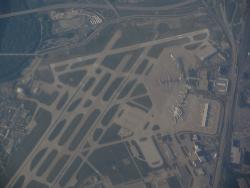
Constructed on 1,040 acres just 10 miles southwest of the city center, the Cleveland Hopkins Airport was the first major airport in the world to provide an integrated system of paved landing surfaces, lighted runways, and a terminal complex consisting of hangars and operating facilities. Overseen by city manager William Hopkins and Major "Jack" Berry - an engineer on loan from the U.S. postal service who eventually became the city's first Airport Commissioner - the project at first was called "Major Berry's Folly" by local residents because of its outlying location.
YearAdded:
Image Credit: Courtesy Flickr/Ken Lund (CC BY-SA 2.0)Image Caption: Cleveland Hopkins AirportEra_date_from: 1925
1979

The Cincinnati Observatory, founded by Ormsby MacKnight Mitchel in 1842, is America’s oldest public/professional observatory. The observatory was situated on Mt. Adams, east of the current downtown Cincinnati; the hill was named for former President John Quincy Adams when he laid the observatory’s cornerstone. In 1873 the observatory was relocated to Mt. Lookout when it became a component of the University of Cincinnati (UC). From 1870s until 1930s the stellar proper motion studies reigned as the observatory’s principal activity.
YearAdded:
Image Credit: Courtesy Wikipedia/Analogue Kid (CC BY-SA 3.0)Image Caption: Cincinnati ObservatoryEra_date_from: 1873
2007
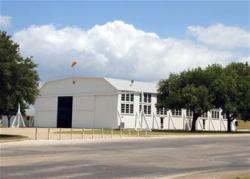
In its infancy, Hangar Nine housed Curtiss JN-4s ("Jennys") like the one Charles Lindbergh landed there when he reported for duty as a flying cadet in 1924.
As the U.S. was preparing to enter World War I, the Army raced to build an entire airfield, complete with 16 wooden hangars, successfully completing it in less than a year. The last remaining World War I facility of its kind, Hangar Nine at Brooks Air Force Base represents the emergence of fast-track construction methods using available materials and the skills of a local workforce.
YearAdded:
Image Credit: Public Domain (U.S. Air Force)Image Caption: Brooks AFB, Old Hangar 9Era_date_from: 1918
1998
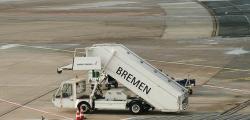
Bremen Airport was founded in 1909. In 1924, German aviation pioneers Henrich Focke and Georg Wulf founded the Focke-Wulf company on the site. On June 26, 1936, Heinrich Focke’s Fw 61, the world’s first fully operational helicopter, made a successful maiden flight at the airport, piloted by Ewald Rohlfs. Other aircraft developed at the site included the Fw 190 fighter plane, and Fa223 helicopter, both used by the German Luftwaffe in World War Two, as well the VAK 191B, an experimental fighter plane with vertical take-off and landing capabilities, developed in the 1970s.
YearAdded:
Image Credit: Courtesy Flickr/Dennis Schmalhausen (CC BY-ND 2.0)Image Caption: An airport baggage car at Bremen AirportEra_date_from: 1909
2011
Innovations