

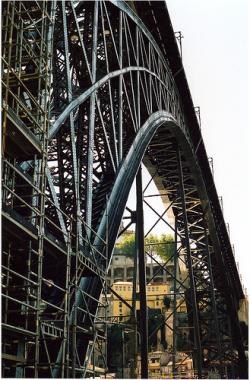
Built to cross one of the steepest valleys along the Douro River, the Ponte Maria Pia was the first major work to emerge from the French firm of Gustav Eiffel and Company, establishing Eiffel as an important bridge designer and civil engineer of his day. Resting on a parabolic arch spanning 160 meters, the Ponte Maria Pia was the longest iron arch bridge in the world at the time of its construction. The bridge's latticework construction reflects the later design of the well-known Eiffel Tower, erected in Paris to commemorate the International Exposition of 1900.
Bridge
YearAdded:
Image Credit: Courtesy Flickr/Kate Watkiss (CC BY 2.0)Image Caption: Ponte Maria Pia BridgeEra_date_from: 1877
1990
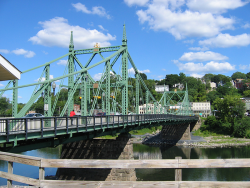
The crossing of the Delaware River at Easton, Pennsylvania, provided a central link in travel from the northeastern seaboard to America's inland territories throughout the 18th and early 19th centuries. From 1806 to the mid-1890s, travelers used a landmark wooden structure built by noted bridge-builder Timothy Palmer. By the 1880s, however, Palmer's three-span covered bridge could no longer handle the demands of traffic generated by new trolley lines.
YearAdded:
Image Credit: Public Domain (National Park Service)Image Caption: Northampton Street BridgeEra_date_from: 1896
1997
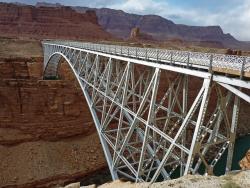
Navajo Bridge spans Marble Canyon, 470 feet above the Colorado River in Grand Canyon National Park. It was considered the highest steel arch bridge in America when completed.
The Navajo Bridge (also known as the Grand Canyon Bridge) was built in 1929 by the Arizona Highway Department and provided a vital transportation link over the Grand Canyon between northern Arizona and southern Utah. Construction commenced by building on one side of the canyon, then on the other, until the two sides met in the middle.
YearAdded:
Image Credit: Courtesy Flickr/Frank Kovalchek (CC BY 2.0)Image Caption: Navajo BridgeEra_date_from: 1929
1997
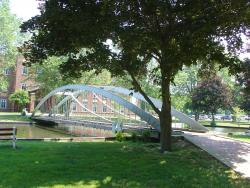
Designed, patented, and built by Thomas W.H. Moseley, this arched 96-foot span bridge preceded by years the standard use of wrought iron for bridges. For the first time in the United States, Moseley incorporated the use of riveted wrought-iron plates for the triangular-shaped top chord.
YearAdded:
Image Credit: Courtesy Wikicommons/Elizabeth Thomsen (CC BY-SA 3.0)Image Caption: Moseley Arch, Merrimack College, North Andover, MassachusettsEra_date_from: 1864
1998
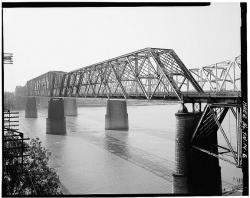
The Memphis Bridge (now called the Frisco Bridge) comprises three spans across the Mississippi River. With a main span measuring over 790 feet, it was one of the longest railroad bridges in the world upon completion. The renowned George Morison, after whom the bridge is unofficially named, served as Chief Engineer.
YearAdded:
Image Credit: Public Domain (National Park Service)Image Caption: Morison's Memphis BridgeEra_date_from: 1892
1987
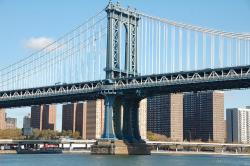
When opened in 1909, the 1,470 foot long main span of the Manhattan Bridge was the third longest suspension bridge span in the world, after the nearby Brooklyn and Williamsburg Bridges. The Manhattan Bridge has two 725 foot long suspended side spans for an overall length of 2,920 feet. The bridge deck is supported by 4 main cables of 20.75 inch diameter, each composed of more than 35,000 individual wires. The bridge deck is stiffened by four parallel trusses of 24 foot depth, hinged at the towers.
YearAdded:
Image Credit: Courtesy Flickr/Dave Herholz (CC BY-SA 2.0)Image Caption: Manhattan BridgeEra_date_from: 1909
2009
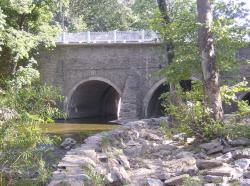
"For 273 years, the little stone bridge that carries Frankford Ave. across Pennypack Creek has been doing its humble job with a minimum of attention..."
- Gerald McKelvey, The Philadelphia Inquirer, September 16, 1970
YearAdded:
Image Credit: Public Domain (National Park Service)Image Caption: Frankford Avenue BridgeEra_date_from: 1697
1970
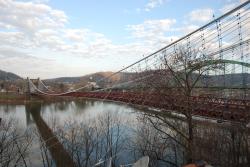
The Wheeling Suspension Bridge was the first bridge to span the Ohio River. It was initially completed in 1849, but destroyed by a tornado five years later. The bridge was rebuilt in 1856. The replacement bridge has the same general appearance of the original structure; the massive towers, anchorage housings, and island approach are all the original stone masonry.
YearAdded:
Image Credit: Photo by Edwin S. Grosvenor (CC BY 2.0)Image Caption: Wheeling Suspension BridgeEra_date_from: 1848
1968
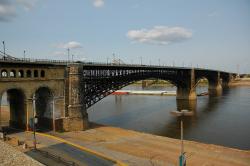
In the decade following the Civil War, the Mississippi River began to lose its standing as the primary transport artery in the Midwest. Railroads were taking over, and Chicago was rapidly becoming the center of Midwestern commerce. The Eads Bridge was the first major railroad link over the Mississippi, constructed by the city of St. Louis in an attempt to maintain its dominance as a regional commercial hub.
YearAdded:
Image Credit: Courtesy Flickr/Patrick Yodarus (CC BY-SA 2.0)Image Caption: Eads BridgeEra_date_from: 1874
1971
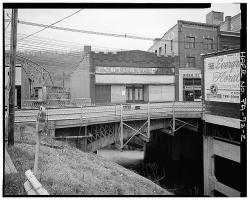
Not only was Dunlap's Creek Bridge the first cast-iron bridge in America, it was the first metal bridge anywhere to use what its builder, Capt. Richard Delafield, U.S. Army Corps of Engineers, described as "standardized, interchangeable, manufactured parts." The bridge was built as part of the federal government's effort to make repairs on the National Road before handing authority over to the states. Dunlap's Creek at Brownsville was an especially troublesome crossing, having destroyed three previous bridges since 1801.
YearAdded:
Image Credit: Public Domain (National Park Service)Image Caption: Dunlap's Creek BridgeEra_date_from: 1939
1978
Innovations