

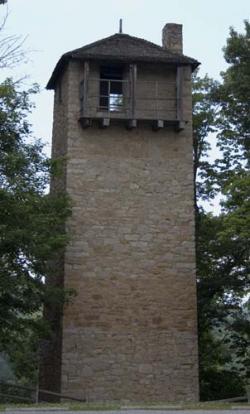
This facility was typical of others in the country that made small spherical lead shot for the fowling pieces of frontier settlers. Smelted lead from the nearby Austinville mines was melted at the top of the tower and poured through a sizing sieve to produce small droplets. Surface tension caused the molted lead to assume a spherical shape that solidified during its 150-foot fall. The shot was then collected in a water-filled kettle at the bottom of the shaft. The "drop process" was patented in England in 1769 by William Watts, a craftsman of Bristol, England.
USA
YearAdded:
Image Credit: Courtesy Wikipedia/Dr00bie (CC BY-SA 3.0)Image Caption: Jackson Ferry Shot TowerEra_date_from: 1807
1981

Frank Zybach, a tenant farmer and inventor living near Strasburg, Colorado, received a patent for a "Self-Propelled Sprinkling Irrigating Apparatus" on July 22, 1952.
The device used mobile towers to continuously move a pipeline in a circle around a pivot. Water was supplied through the pivot and distributed by sprinklers on the pipeline. Zybach formed a partnership with A.E. Trowbridge, an entrepreneur-businessman, in 1953 to manufacture center pivots in Columbus, Nebraska.
YearAdded:
Image Credit: U.S. Department of Agriculture photoImage Caption: The Center Pivot Irrigator transformed agricultural production throughout the world.Era_date_from: 1952
1993

"At 10:30 p.m., 29 October 1969, the first ARPANET message was sent from this UCLA site to the Stanford Research Institute. Based on packet switching and dynamic resource allocation, the sharing of information digitally from this first node of ARPANET launched the Internet revolution."
(The plaque can be seen at the UCLA Henry Samueli School of Engineering and Applied Sciences, 405 Hilgard Ave., Los Angeles, California, U.S.A.)
The deployment of the ARPANET set in motion a train of developments that led to the Internet as we know it today.
YearAdded:
Image Credit: Courtesy Flickr/FastLizard4 (CC BY-SA 2.0)Image Caption: The original Interface Message Processor, a primitive router, and considered widely to be the beginning (or "birth") of the internetEra_date_from: 1969
2009
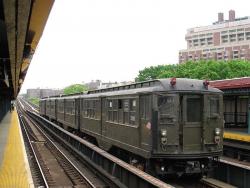
Plans to build a rapid transit system in New York were first made in 1831. By 1868 the first elevated railway was erected. As the "El" became crowded, construction of an underground railway was proposed. Ground was broken on March 24, 1900. The original subway, which took opened October 27, 1904, ran 9.1 miles from City Hall to 145th Street and Broadway. The fare was a nickel. Extensions to the Bronx opened in 1905 and to Brooklyn in 1908, completing the first subway.
YearAdded:
Image Credit: Courtesy Wikipedia/Adam E. Moreira (CC BY-SA 3.0)Image Caption: Interborough Rapid Trasit System Original LineEra_date_from: 1904
1978
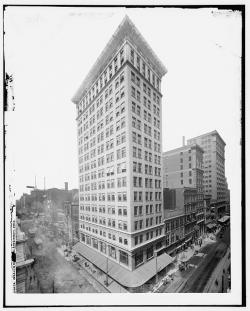
The 16-story Ingalls Building, still in use today, was the world's first reinforced concrete skyscraper. Its success led to the acceptance of high-rise concrete construction in the United States.
Melville E. Ingalls, for whom the building is named, spent two years convincing city officials to issue a building permit. Skepticism was high, because the existing height record for a concrete building was only six stories.
YearAdded:
Image Credit: Public Domain; Produced prior to 1/1/1923Image Caption: Ingalls BuildingEra_date_from: 1903
1973
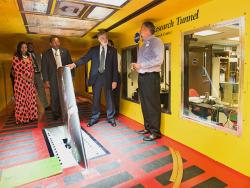
In operation since 1944, the Icing Research Tunnel is the oldest and largest refrigerated icing wind tunnel in the world. Technology developed there enables aircraft to fly safely through icing clouds. Two firsts include the unique heat exchanger and the spray system that simulates a natural icing cloud of tiny droplets.
YearAdded:
Image Credit: Courtesy NASAImage Caption: Cleveland Mayor, Frank G. Jackson, tours the Icing Research TunnelEra_date_from: 1944
1987
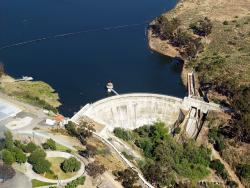
When completed in 1888 to a height of 90 feet, Sweetwater Dam was once the tallest masonry arch dam in the United States, and it led to many others of the same basic design. The original construction began in November 1886 under the direction of Frank E. Brown (civil engineer for Bear Valley Dam) with the rubble-masonry thin-arch design being 50 feet in height. Subsequently, the owner of the water system called upon civil engineer James D. Schuyler to continue and complete the project. Although the field of hydrology was very new and not fully understood at the time, Mr.
YearAdded:
Image Credit: Courtesy Flickr/Phil Konstantin (CC BY 2.0)Image Caption: Sweetwater DamEra_date_from: 1888
2005
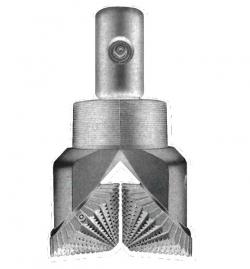
Prior to 1909 the traditional fishtail bit scraped the rock and quickly dulled in service. The Hughes two-cone bit's revolutionary rolling action crushed hard-rock formations with twin cone-shaped, hardened steel bits, each with 166 cutting edges, revolving on bronze bearings shaped to provide a large surface with reduced friction.
YearAdded:
Image Credit: Courtesy ASMEImage Caption: Hughes Two-Cone Drill BitEra_date_from: 1909
2009
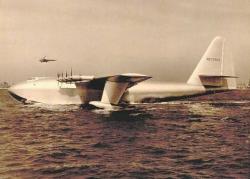
Better known as the "Spruce Goose," the Howard Hughes Flying Boat was designed and built by Hughes Aircraft Co., to be the largest wood-constructed and the largest wingspan airplane ever built. As Hughes perfected his craft, he added significantly to what is known in areas of large-lift capability and power-boost systems. Originally designated the HK-1 in 1942, it was designed to meet wartime troop and material transportation needs (flying just high enough to evade submarine attacks).
YearAdded:
Image Credit: Public Domain (Federal Aviation Administration)Image Caption: Howard Hughes Flying Boat, HK-1Era_date_from: 1947
2002

The 50-mile Houston Ship Channel is a manmade port for ocean-going vessels, stretching from the Gulf of Mexico to Houston and Harris County, Texas.
YearAdded:
Image Credit: Courtesy Flickr/Roy Luck (CC BY 2.0)Image Caption: Houston Ship ChannelEra_date_from: 1837
1987
Innovations