
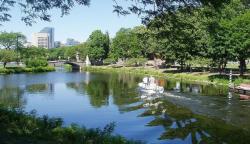
The Charles River Basin was one of the pioneering environmental engineering projects in America. The project transformed 675 acres of unhealthy and unsightly salt marshes and tidal flats were into an environmental centerpiece for the Boston area by 1910. This was one of the first public projects to radically improve the environment and has served as a model for similar projects around the nation.
USA
YearAdded:
Image Credit: Courtesy Wikipedia/Daderot (CC BY-SA 3.0)Image Caption: Charles River Basin ProjectEra_date_from: 1910
1981
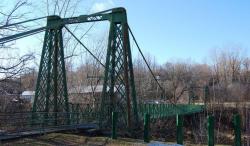
A 214-foot single-span covered wooden bridge, built above the cribs of stone in the AuSable River that served to break log jams and ice floes, collapsed during the winter of 1875 under the weight of a three-foot snowfall and high winds. The "Upper Bridge" (pictured) was built in its place.
YearAdded:
Image Credit: Public Domain (Released by Creator)Image Caption: The Keeseville Suspension Bridge built 1888, Keeseville, one of the three "Bridges of Keeseville" that span the AuSable RiverEra_date_from: 1878
1987
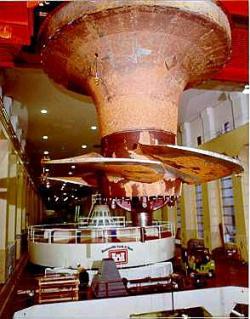
This Kaplan turbine is one of the first three machines to be put into service in the United States. Named for its Austrian inventor, Viktor Kaplan (1876-1934), the turbine was an outstanding innovation, operating with a high, nearly constant efficiency over a wide load range. The machine was built by S. Morgan Smith Company of York, Pennsylvania.
YearAdded:
Image Credit: Public Domain (United States Arm0Image Caption: Kaplan TurbineEra_date_from: 1929
1980

The Kamehameha V Post Office is the oldest surviving public building in the U.S. constructed with reinforced concrete. The success of this early structure helped establish the value of reinforced concrete as a durable construction material.
Brickmaker J.G. Osborne was chosen to provide design and construction. He immigrated to Hawaii from Yorkshire, England, and was aware of the recent development of Portland cement and its expanding use in Europe. It is believed that the leaders of Hawaii were anxious to adopt British skills, which influenced their selection of Osborne.
YearAdded:
Image Credit: Public Domain (Author's Choice)Image Caption: Kamehameha V Post OfficeEra_date_from: 1871
1987
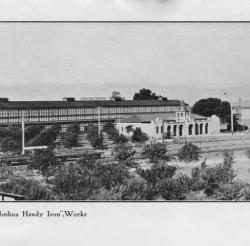
This ironworks exemplified the adaptability required for industrial survival in a dynamic technical environment. It was a major western producer of mechanical equipment used in mining (especially large hydraulic machines), ship propulsion, irrigation, power generation, optical telescope mounts, and nuclear research.
YearAdded:
Image Credit: Public DomainImage Caption: Joshua Hendy Iron WorksEra_date_from: 1906
1978
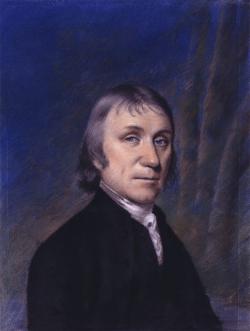
When Joseph Priestley discovered oxygen in 1774, he answered age-old questions of why and how things burn. An Englishman by birth, Priestley was deeply involved in politics and religion, as well as science. When his vocal support for the American and French revolutions made remaining in his homeland dangerous, Priestley left England in 1794 and continued his work in America until his death. His library of some 1,600 volumes and his chemical laboratory, where he first isolated carbon monoxide, were probably the best in the country at that time.
YearAdded:
Image Credit: Public Domain; Produced prior to 1/1/1923Image Caption: Joseph Priestley: Discoverer of OxygenEra_date_from: 1774
2000

This is one of several, similar inclines built in western Pennsylvania during the late 19th century. It was designed by Samuel Diescher (1839-1915) after the great flood of 1889, to provide an efficient means of transportation between Westmont and the Conemaugh Valley. (See also the Monogahela and Duquesne Inclines in Pittsburgh.)
YearAdded:
Image Credit: Courtesy Flickr/Jeremy Tenenbaum (CC BY 2.0)Image Caption: Johnstown InclineEra_date_from: 1891
1994
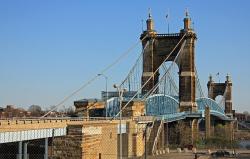
In 1866, the Covington and Cincinnati Suspension Bridge was the largest suspension bridge in the world. Also called the Ohio Bridge, it was officially renamed the John A. Roebling Bridge in 1983. It was the first permanent bridge over the Ohio River and the only public project in America financed by private investors during the Civil War.
Renowned bridge designer John A. Roebling proposed the structure in 1846; but building the bridge would become a 20-year saga, with heated lobbying both for and against the crossing.
YearAdded:
Image Credit: Courtesy Flickr/Tom Hamilton (CC BY 2.0)Image Caption: John A. Roebling BridgeEra_date_from: 1866
1982
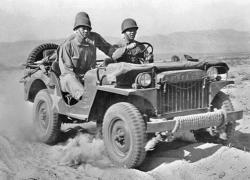
Although not the first four-wheel-drive vehicle or the first designed for rough, multipurpose field use, the Jeep MB was built as an unusual combination of these and other features of modern vehicle design in the World War II era.
YearAdded:
Image Credit: Public Domain (United States Army)Image Caption: Jeep Model MBEra_date_from: 1947
1991
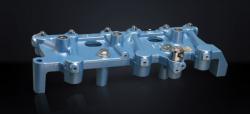
The Jake Brake permits large trucks to descend long, steep grades at a controlled speed. It was the first practical mechanism for altering on demand the valve timing on a truck diesel engine, thereby converting the engine to a power absorbing machine. The modified engine can continue to power the truck in normal operation, allowing service brakes to remain cool for emergency situations. Invented by Clessie Lyle Cummins (1886-1968), this device (produced by the Jacobs manufacturing company since 1961) has contributed significantly to highway safety.
YearAdded:
Image Credit: Courtesy Wikipedia/Sierra Fournier (CC BY-SA 3.0)Image Caption: Jacobs Engine Brake Retarder ("Jake Brake")Era_date_from: 1957
1985
Innovations