

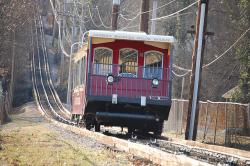
At the mountain where the Civil War's Battle Above the Clouds was waged, tourist business has thrived from the building of its first toll road (Whiteside Pike) in 1857 to present day.
USA
YearAdded:
Image Credit: Courtesy Flickr/Duane Tate (CC BY 2.0)Image Caption: Lookout Mountain Incline RailwayEra_date_from: 1895
1991
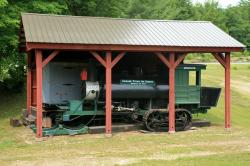
This steam crawler-tractor emancipated horses from the killing work of hauling trains of sleds over iced roads in the winter woods of the United States and Canada.
Designed, patented (1901), and built by Alvin C. Lombard (1856-1937) of Waterville, Maine, eighty-three "Lombards" were the first practical examples of the often-tried lag or crawler tread that would become the mark of the internal combustion engine-driven agricultural and construction equipment and military tank in current use.
YearAdded:
Image Credit: Courtesy Flickr/cliff1066,Image Caption: Lombard Steam Log HaulerEra_date_from: 1910
1982
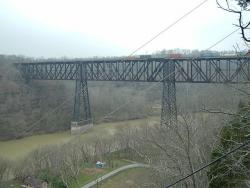
In the 1850s, the Lexington and Danville Railroad began building a suspension bridge over the Kentucky River. The bridge was designed by John A Roebling. Due to unforeseen increases in train loads, the Roebling bridge was never completed. The High Bridge would then be built 20 years later on the existing foundations.
YearAdded:
Image Credit: Public Domain (Author's Choice)Image Caption: High BridgeEra_date_from: 1877
1985
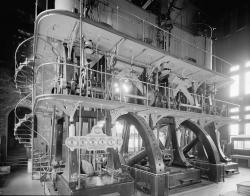
This machine is an unusual triple-expansion, three-crank rocker engine, which in its day was a high-capacity unit providing outstanding performance for the Boston Water Works Corporation. Designed by Erasmus Darwin Leavitt, Jr. (1836-1916), Engine No. 3 was installed in 1894 to a high-service pumping facility on the south side of the Chestnut Hill Reservoir in Brighton.
YearAdded:
Image Credit: Public Domain (National Park Service)Image Caption: Leavitt-Riedler Pumping EngineEra_date_from: 1894
1973
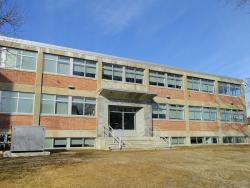
Some of the station's notable achievements:
The first method for detecting radioactive particles in water supplies
A successful system of slow-sand filter beds for drinking water
The landmark demonstration that microorganisms carried within filter media could degrade sewage
YearAdded:
Image Credit: Public Domain (Author's Choice)Image Caption: Lawrence Experiment StationEra_date_from: 1886
1975
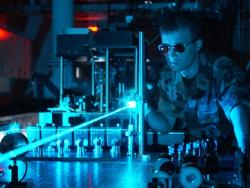
As ideas developed, they abandoned infrared radiation to instead concentrate upon visible light. The concept originally was called an "optical maser". In 1958, Bell Labs filed a patent application for their proposed optical maser; and Schawlow and Townes submitted a manuscript of their theoretical calculations to the Physical Review, published that year in Volume 112, Issue No. 6.
Simultaneously, at Columbia University, graduate student Gordon Gould was working on a doctoral thesis about the energy levels of excited thallium.
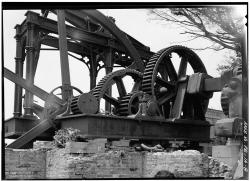
The La Esperanza sugar mill steam engine is one of the few remaining American links to the pioneer beam engines of the English inventors Thomas Newcomen (1712) and James Watt (1769). The engine was built in 1861 in Cold Spring, New York, by the West Point Foundry. The general arrangement and details, including the Gothic embellishment, are typical of machinery of the period. The straight-line motion of the piston rod is accommodated to the arc of the moving beam end by a parallel motion. Watt regarded this ingenious linkage as the invention of which he was most proud.
YearAdded:
Image Credit: Public Domain (National Park Service)Image Caption: Hacienda La Esperanza Sugar Mill Steam EngineEra_date_from: 1861
1979
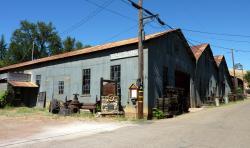
This is one of the earliest US foundry-machine shops remaining in operation and one of the few water powered. It was founded by Samuel N. Knight (1838-1913) to manufacture machinery for the gold mines of the Mother Lode region. Knight was one of several inventors experimenting with impulse turbines to exploit the area's abundant high-head water power for driving hoists, ore stamps, and other mining machinery.
YearAdded:
Image Credit: Courtesy Wikipedia/Bobak Ha'Eri (CC BY 3.0)Image Caption: Knight Foundry and Machine ShopEra_date_from: 1873
1995
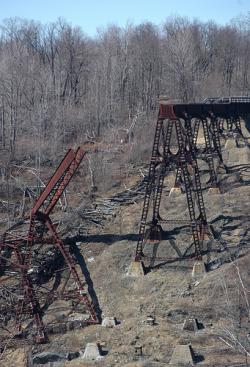
The workforce consisted of less than 100 men, yet they finished construction in just 94 days. Such speed was possible due to the elimination of scaffolding. Instead, iron rods were used to support construction of the trusses between the towers, and workers moved back and forth across the rods. A dangerous venture, yet no workers were seriously injured.
YearAdded:
Image Credit: Courtesy Flickr/Peter Pawlowski (CC BY 2.0)Image Caption: Kinzua Railway ViaductEra_date_from: 1882
1982
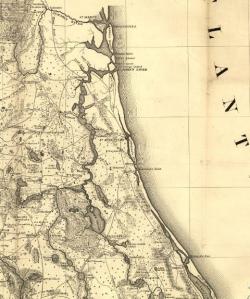
When Governor James Grant arrived in the newly acquired British colony of East Florida in 1764, he found it devoid of settlers. To increase both the population and commerce with the 13 colonies to the north, he commanded that a road be built from his provincial capital of St. Augustine to Ft. Barrington, Georgia.
YearAdded:
Image Caption: Section of a map showing King's Road in the Territory of Florida, by the United States Army Corps of Engineers, published in 1839.Era_date_from: 1775
1976
Innovations