

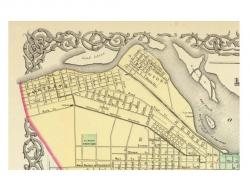
Chartered in 1825, the Louisville and Portland Canal Company was authorized to construct a canal around the rapids called the "Falls of the Ohio." Construction started on March 1, 1826. The canal and first generation of locks were completed in 1830. As originally constructed, the canal was 1.9 miles long, 64 feet wide, and terminated at its lower end with a three-flight lock system with a total lift of 26 feet. Each lock chamber was 198 feet long between miter posts, with available length for vessels of 183 feet, width of 52 feet, and a lift at low stages of 8.5 feet.
1830-1839
YearAdded:
Image Credit: public domainImage Caption: The Louisville and Portland Canal was completed in 1830.Era_date_from: 1830
2002
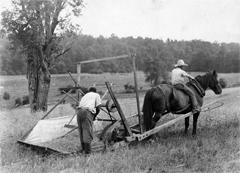
McCormick was born on the 620-acre farm known historically as “Walnut Grove Farm” in 1809. He built the first practical grain reaper, which was successfully demonstrated in a field of oats owned by John Steele in nearby Steeles Tavern in 1831.
YearAdded:
Image Credit: Courtesy of the Shenandoah Valley Agricultural Research and Extension Center.Image Caption: The McCormick reaper was first demonstrated at the Walnut Grove Farm in Virginia.Era_date_from: 1831
1972
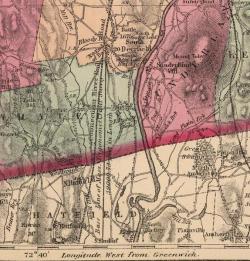
The Borden Base Line is a 39,009.73 feet (7.42 miles ) survey line through the State of Massachusetts. The line was the first project of its kind undertaken in America and its establishment was the key element for Massachusetts pioneering mandate to survey the entire state.
The challenge was to use trigonometrical principles, instead of astronomical observation alone, to provide greater accuracy in surveying large areas.
YearAdded:
Image Credit: Public Domain (Copyright Exp.)Image Caption: An 1871 map of Massachusetts highlighting the Borden Base LineEra_date_from: 1831
1981
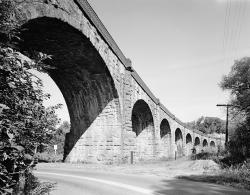
Opened in 1835, the Thomas Viaduct was the first multiple-arch, stone railroad viaduct in the United States. The viaduct is composed of eight arches each with a clear span of about 58 feet. The viaduct has an overall length of 614 feet and a height of about 60 feet above the Patapsco River. Construction of the viaduct began in August of 1833, and a ceremony marking its completion was conducted on July 4, 1835. The viaduct was constructed for the Baltimore and Ohio (B&O) Railroad and is named in honor Philip E. Thomas, who served from 1827 to 1836 as the first president of the B&O.
YearAdded:
Image Credit: Public Domain (National Park Service)Image Caption: Thomas Viaduct Railroad BridgeEra_date_from: 1835
1964
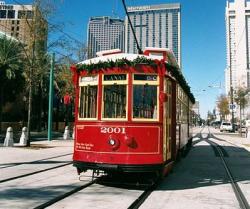
New OrleansState: LACountry: USAWebsite: http://www.asme.org/about-asme/history/landmarks/topics-m-z/rail-transportation---2/-101-st--charles-avenue-streetcar-line-%281835%29, https://www.asme.org/getmedia/40ef6e7c-697d-4f77-8daa-059a37f698b3/101-St-Charles-Avenue-Streetcar-Line-1835.aspxCreator: Perley A. Thomas Car Company
The St. Charles Avenue Streetcar Line is the oldest surviving interurban-urban passenger rail transportation system in the United States. Originally incorporated as the New Orleans Carrollton Rail Road in 1833, service began in 1835. A variety of motive power had been used including horses, mules, overhead cable, steam engines, and ammonia engines before electrification in 1893. The 900-series cars presently in service were designed and built by the Perley A. Thomas Car Company of High Point, North Carolina, in 1923 to 1924.
YearAdded:
Image Credit: Original Image: Courtesy Wikipedia/Falkue (CC BY-SA 3.0)Image Caption: St. Charles Avenue Streetcar LineEra_date_from: 1835
1984

The 50-mile Houston Ship Channel is a manmade port for ocean-going vessels, stretching from the Gulf of Mexico to Houston and Harris County, Texas.
YearAdded:
Image Credit: Courtesy Flickr/Roy Luck (CC BY 2.0)Image Caption: Houston Ship ChannelEra_date_from: 1837
1987
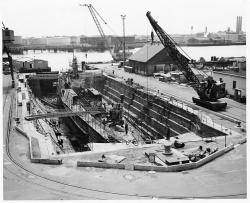
Baldwin's dry dock in Virginia has been designated a National Historical Landmark and is still in use at the Norfolk Naval Shipyard. The Charlestown dry dock and original pump house, while no longer used, are on display as part of the Boston National Historical Park.
Although the need for dry-docking facilities to speed the cleaning and repair of ships in America's naval fleet was apparent as early as 1789, it was the War of 1812, and the burning of Washington, D.C., that finally convinced Congress of the importance of a coastal defense system based on a strong navy.
YearAdded:
Image Credit: Public Domain (National Park Service)Image Caption: Gosport Naval Dry DocksEra_date_from: 1834
1977
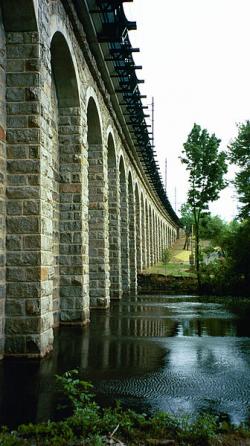
For more than 174 years, the Canton Viaduct has stood as a dominating structure on the New England landscape. When completed in 1835, the slightly curved, granite masonry bridge - 615 feet long, 70 feet high, and 22 feet wide - carried a single track of the Boston and Providence Railroad, providing a critical link in the establishment of rail service between Boston and New York. In 1860, a second track was added. With few major alterations, the viaduct has continued to provide safe rail transportation to heavier and faster loads throughout the 20th century.
YearAdded:
Image Credit: Public Domain (Author's Choice)Image Caption: Canton ViaductEra_date_from: 1835
1998
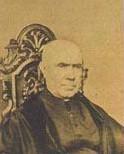
A pioneer in the development of electrical science, Nicholas Joseph Callan was born on 22 December 1799 in Darver, Ireland. He started the priesthood at Navan Seminary, and continued his studies at St. Patrick’s College Maynooth, where he studied natural and experimental philosophy under Dr. Cornelius Denvir. After his ordination as priest in 1823, Callan pursued his doctorate in divinity in Rome, where he became acquainted with Galvani and Volta’s work in the study of electricity, and recognized the potential to put it to practical and commercial use with powerful batteries.
YearAdded:
Image Credit: Public Domain; Produced prior to 1/1/1923Image Caption: Callan's Pioneering Contributions to Electrical Science and TechnologyEra_date_from: 1836
2006
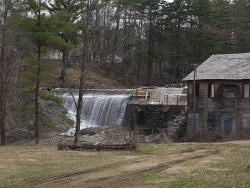
Ithamar A. Beard, an engineer of some prominence in New England, surveyed the mill brook and selected the best site for a storage dam. Contractor Simeon Cobb, knowledgeable of contemporary civil engineering practices, made major changes to the dam's original design, converting the linear dam into a gentle arch.
YearAdded:
Image Credit: Courtesy Wikipedia/Ymblanter (CC BY-SA 3.0)Image Caption: The Ascutney Mill Arch-Gravity DamEra_date_from: 1834
1970
Innovations
Farm And Residence of John Johnston 1791 - 1880 Eminent Farmer Who Here Originated Tile Underdrainage in America in 1835 and Thereby Became an Outstanding Contributor to Human Welfare Honored by The American Society of Agricultural Engineers 1935. Erected by State Education Department…
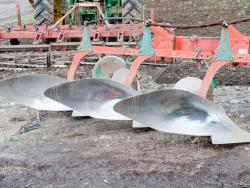
On this site in 1837 John Deere built the first successful self-scouring steel plow, thereby making a significant contribution to the development of American agriculture. Dedicated by American Society of Agricultural Engineers 1976
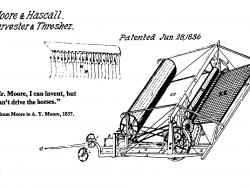
A Historic Landmark of Agricultural Engineering in 1834 Near the Village of Climax, Michigan, Hiram Moore and John Hascall Built and Put Into Practical Use the First Successful Grain Combined Harvester - Thresher Which was Patented June 28, 1836. This Achievement was a Significant…
Read More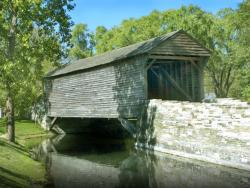
Ackley Bridge is an excellent example of a multiple kingpost truss and a noteworthy early example of covered bridge preservation efforts in the United States. Built in 1832 by Joshua Ackley (b.1805) and Daniel Clouse (b.1812), Ackley Bridge originally spanned Enslow’s Branch of Wheeling Creek…
Read MoreASM International has designated Brownsville - Route 40 Bridge an historical landmark. This bridge, designed by and built under the supervision of Capt. Richard Delafield in 1839 to improve the "National Road", is the first cast iron bridge to be built west of the Allegheny Mountains.