
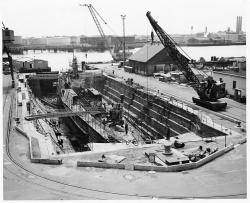
Baldwin's dry dock in Virginia has been designated a National Historical Landmark and is still in use at the Norfolk Naval Shipyard. The Charlestown dry dock and original pump house, while no longer used, are on display as part of the Boston National Historical Park.
Although the need for dry-docking facilities to speed the cleaning and repair of ships in America's naval fleet was apparent as early as 1789, it was the War of 1812, and the burning of Washington, D.C., that finally convinced Congress of the importance of a coastal defense system based on a strong navy.
USA
YearAdded:
Image Credit: Public Domain (National Park Service)Image Caption: Gosport Naval Dry DocksEra_date_from: 1834
1977
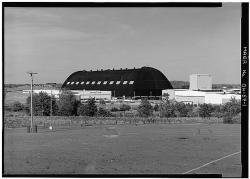
Wind dynamics were a major consideration in building such a huge structure. When winds blow against the building, they are deflected up over the roof, creating a partial vacuum that can draw the roof up with a force several times greater than the direct force of the wind. Wind tunnel testing on a model helped designers decide that a semi-parabolic shape would best resolve air current concerns.
YearAdded:
Image Credit: Public Domain (National Park Service)Image Caption: Goodyear AirdockEra_date_from: 1929
1980
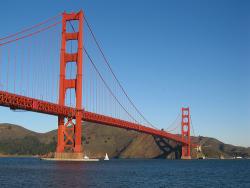
Put in service in 1937, this world-renowned bridge, conceived by Joseph Strauss and designed largely by Charles Ellis, was the longest single span (4,200 feet) in the world for a quarter century.
As with many civil engineering projects in their conceptual stages, naysayers scoffed at the Golden Gate Bridge. They said it would be technically unfeasible or too expensive to bridge the Golden Gate, a 1.7-mile-wide opening separating the Pacific Ocean from the San Francisco Bay. They said that the channel was too deep; the tides and winds too strong; the span too long.
YearAdded:
Image Credit: Courtesy Flickr/Salim Virji (CC BY-SA 2.0)Image Caption: Golden Gate BridgeEra_date_from: 1937
1984
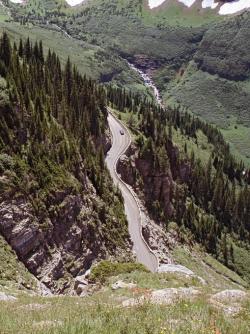
Considered one of the world's most scenic mountain drives, the two-lane Going-To-The-Sun Road through Glacier National Park was the first major road to be constructed directly over high mountain terrain, proving that roads did not need to be limited to mountain passes.
YearAdded:
Image Credit: Original Image: Flickr/Katie BradyImage Caption: Going-to-the-Sun RoadEra_date_from: 1932
1985
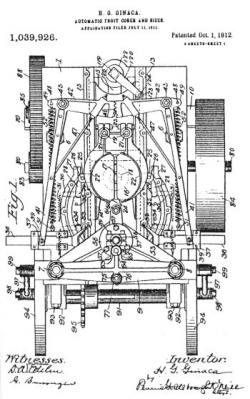
Commercial pineapple production began in Hawaii about 1890. Fruit was hand-peeled and sliced to match can sizes for export. In 1911 James D. Dole hired Henry G. Ginaca to design a machine to automate the process. As fruit dropped through the Ginaca machine, a cylinder was cut to proper diameter, trimmed top and bottom, and cored. This machine more than tripled production, making pineapple Hawaii's second largest crop.
YearAdded:
Image Credit: Public Domain (United States Patent)Image Caption: Ginaca Pineapple Processing MachineEra_date_from: 1911
1993
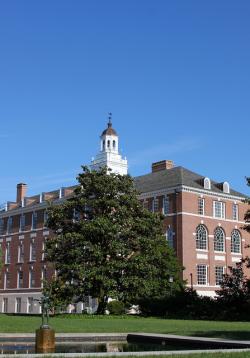
Gilman Hall, built in 1916-1917, accommodated a growing College of Chemistry by providing expanded research and teaching facilities for faculty and students specializing in physical, inorganic and nuclear chemistry. Work performed at Gilman Hall helped advance the fields of chemical thermodynamics and molecular structure, and has resulted in multiple Nobel Prizes. The Hall is most famous for the work of Glenn T. Seaborg and his coworkers, which included the successful identification and production the element Plutonium. Seaborg received the Nobel Prize in 1951 for his accomplishments.
YearAdded:
Image Credit: Courtesy Flickr/Waqas Bhatti (CC BY-SA 2.0)Image Caption: Gilman HallEra_date_from: 1917
1997

The Georgetown Steam Plant, a surprisingly complete and operable steam power plant after a career of nearly seventy-five years, was built in the early 1900s when Seattle's inexpensive hydroelectric power attracted manufacturers. Much of the power produced at this plant operated the streetcars. It marks the beginning of the end of the reciprocating steam engine's domination in the growing field of electrical energy generation for lighting and power.
YearAdded:
Image Caption: Georgetown Steam Hydro Generating PlantEra_date_from: 1906
1980
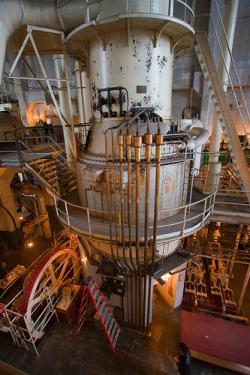
The Georgetown Steam Plant, a surprisingly complete and operable steam power plant after a career of nearly seventy-five years, was built in the early 1900s when Seattle's inexpensive hydroelectric power attracted manufacturers. Much of the power produced at this plant operated the streetcars.
YearAdded:
Image Credit: Courtesy Flickr/wneuetc (CC BY-ND 2.0)Image Caption: Georgetown Steam PlantEra_date_from: 1906
1980
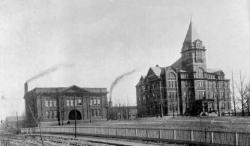
Between its opening in 1888 and the mid-1920s, Georgia Tech took a leading role in transforming mechanical engineering education from a shop-based, vocational program to a professional one built on rigorous academic and analytical methods.
Led by John Saylor Coon (1854-1938), a founding member of ASME, this curriculum merged theoretical understanding with practical experience. By bringing Coon on board so soon after the school's founding, Tech began this transition almost from day one, even though it took three decades to completely effect it.
YearAdded:
Image Credit: Public Domain (Copyright Expired)Image Caption: On Left: Georgia Tech's shop building2000
On Right: Tech Tower
Photo circa 1899Era_date_from: 1888
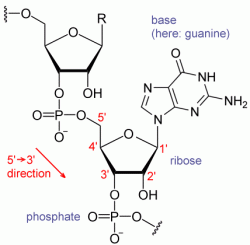
In 1961, in the National Institutes of Health Headquarters (Bethesda, MD), Marshall Nirenberg and Heinrich Matthaei discovered the key to breaking the genetic code when they conducted an experiment using a synthetic RNA chain of multiple units of uracil to instruct a chain of amino acids to add phenylalanine. The uracil (poly-U) served as a messenger directing protein synthesis. This experiment demonstrated that messenger RNA transcribes genetic information from DNA, regulating the assembly of amino acids into complex proteins.
YearAdded:
Image Credit: Courtesy Wikipedia/Infocan (CC BY-SA 3.0)Image Caption: Deciphering the Genetic CodeEra_date_from: 1961
1997
Innovations