

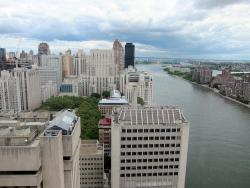
For more than a century, scientists at Rockefeller University have enhanced our understanding of the molecular basis of life — specifically the relationship between the structure and function of nucleic acids and proteins. They showed that DNA transfers genetic information and that the sugars ribose and deoxyribose are the key building blocks of the nucleic acids RNA and DNA.
1900-1909
YearAdded:
Image Credit: Courtesy Flickr/S Shepherd (CC BY 2.0)Image Caption: Nucleic Acid and Protein Chemistry Research at Rockefeller UniversityEra_date_from: 1901
2000
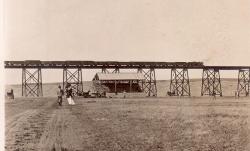
The Northern Pacific High Line Bridge No. 64, built between 1907 and 1908, has continued to perform yeoman service in the uninterrupted flow of the Nation's commerce. Nearly, 100 years after this bridge officially opened, it still carries 125-ton car unit coal trains, double stack container trains, lumber, and refined products at train speeds of 50 m.p.h.
YearAdded:
Image Credit: Original Photo: Public Domain; Produced prior to 1/1/1923Image Caption: Northern Pacific High Line Bridge No 64Era_date_from: 1908
2004
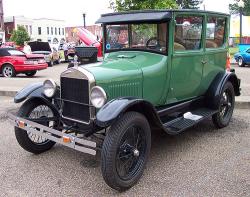
DearbornState: MICountry: USAWebsite: https://www.asme.org/about-asme/who-we-are/engineering-history/landmarks/233-model-tCreator: Ford Motor Company, Wills, Childe
When Ford Motor Company introduced its new Model T on October 1, 1908, even an inveterate optimist like Henry Ford (1863-1947) could not predict the vast changes that his rather homely new vehicle would produce. What flowed from this series of bold innovations was more than an endless stream of Model Ts — it was the very foundation of the twentieth century itself. The assembly line became the century's characteristic production mode, eventually applied to everything from phonographs to hamburgers.
YearAdded:
Image Credit: Courtesy Flickr/Don O'Brien (CC BY 2.0)Image Caption: Model TEra_date_from: 1908
2005
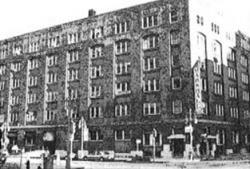
Designed by Claude A. P. Turner, a pioneer of reinforced concrete construction, the Marshall Building was constructed originally in 1906 as a five-story building. In 1911 the sixth floor of the building was added as per Turner's original design. This building is the oldest extant example of Turner's "mushroom" flat-slab system which transformed the design and construction of reinforced-concrete floors worldwide.
YearAdded:
Image Credit: Courtesy ASCEImage Caption: Marshall BuildingEra_date_from: 1906
2002
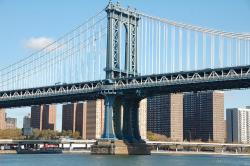
When opened in 1909, the 1,470 foot long main span of the Manhattan Bridge was the third longest suspension bridge span in the world, after the nearby Brooklyn and Williamsburg Bridges. The Manhattan Bridge has two 725 foot long suspended side spans for an overall length of 2,920 feet. The bridge deck is supported by 4 main cables of 20.75 inch diameter, each composed of more than 35,000 individual wires. The bridge deck is stiffened by four parallel trusses of 24 foot depth, hinged at the towers.
YearAdded:
Image Credit: Courtesy Flickr/Dave Herholz (CC BY-SA 2.0)Image Caption: Manhattan BridgeEra_date_from: 1909
2009
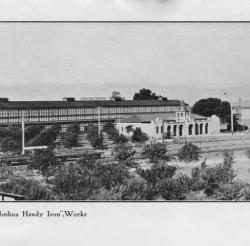
This ironworks exemplified the adaptability required for industrial survival in a dynamic technical environment. It was a major western producer of mechanical equipment used in mining (especially large hydraulic machines), ship propulsion, irrigation, power generation, optical telescope mounts, and nuclear research.
YearAdded:
Image Credit: Public DomainImage Caption: Joshua Hendy Iron WorksEra_date_from: 1906
1978
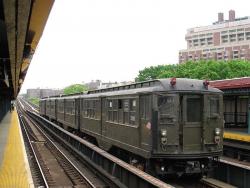
Plans to build a rapid transit system in New York were first made in 1831. By 1868 the first elevated railway was erected. As the "El" became crowded, construction of an underground railway was proposed. Ground was broken on March 24, 1900. The original subway, which took opened October 27, 1904, ran 9.1 miles from City Hall to 145th Street and Broadway. The fare was a nickel. Extensions to the Bronx opened in 1905 and to Brooklyn in 1908, completing the first subway.
YearAdded:
Image Credit: Courtesy Wikipedia/Adam E. Moreira (CC BY-SA 3.0)Image Caption: Interborough Rapid Trasit System Original LineEra_date_from: 1904
1978
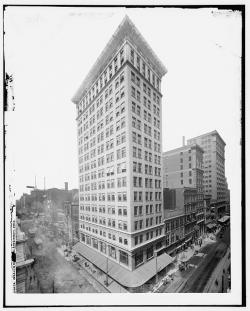
The 16-story Ingalls Building, still in use today, was the world's first reinforced concrete skyscraper. Its success led to the acceptance of high-rise concrete construction in the United States.
Melville E. Ingalls, for whom the building is named, spent two years convincing city officials to issue a building permit. Skepticism was high, because the existing height record for a concrete building was only six stories.
YearAdded:
Image Credit: Public Domain; Produced prior to 1/1/1923Image Caption: Ingalls BuildingEra_date_from: 1903
1973
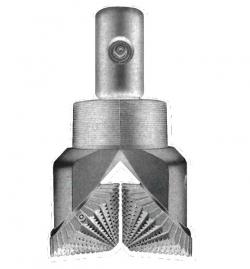
Prior to 1909 the traditional fishtail bit scraped the rock and quickly dulled in service. The Hughes two-cone bit's revolutionary rolling action crushed hard-rock formations with twin cone-shaped, hardened steel bits, each with 166 cutting edges, revolving on bronze bearings shaped to provide a large surface with reduced friction.
YearAdded:
Image Credit: Courtesy ASMEImage Caption: Hughes Two-Cone Drill BitEra_date_from: 1909
2009
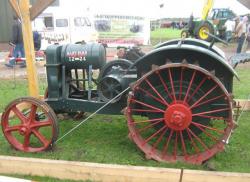
This landmark artifact represents the first commercially successful farm tractor in the world powered by an internal-combustion engine. It was invented and built by Charles W. Hart and Charles H. Parr in Charles City, Iowa, as their Model 3, following two prototype versions.
YearAdded:
Image Credit: Courtesy Flickr/Norbert Schnitzler (CC BY-SA 2.0)Image Caption: Hart Parr TractorEra_date_from: 1903
1996
Innovations
On 19 August, the AIAA Historic Aerospace Sites Committee dedicated Kitty Hawk, NC, as a historic aerospace site, following a decades-long negotiation with the U.S Park Service. A historic marker was unveiled at a 0930 hrs ceremony as part of the First Flight Society’s National Aviation Day at…
Read More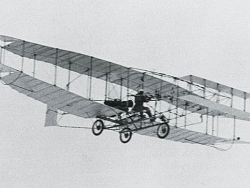
AIAA designated Baddeck, Nova Scotia as a historic site, providing a plaque to commemorate the centennial of the first powered flight in Canada. On February 23, 1909, piloting the “Silver Dart,” J.A. Douglas McCurdy took off from the frozen surface of Bras d’Or Lake at Baddeck Bay, and flew for…
Read More
American Society of Agricultural Engineers Founded in this Building December 27, 1907
ASM International - The Materials Information Society - has designated Heroult Electric Arc Furnace an Historical Landmark. In 1907, at Shasta County, the first electric arc furnace in the western hemisphere was utilized for the direct production of iron from this area’s indigenous resources of…
Read MoreHammondsport is the proud hometown of Glenn H. Curtiss, a legendary figure in early flight and the Father of Naval Aviation. It was here, between 1904 and 1915, that Curtiss collaborated with other aviation pioneers, including Alexander Graham Bell, to foster significant advancements in the…
Read More