

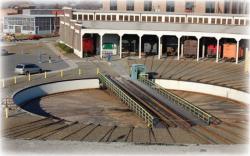
A majority of the buildings, used originally in steam locomotive repair and maintenance, are still intact, including the backshop (erecting shop), roundhouse, flue shop, paint shop, and parts storage buildings. The 37-stall roundhouse is one of the largest remaining roundhouses in North America still in continuous operation. The site contains other significant buildings including the car repair shed, yard office, oil house, sand house, and wheel balancing shed.
USA
YearAdded:
Image Credit: Courtesy ASMEImage Caption: The Bob Julian Roundhouse, part of Southern Railway Spencer ShopsEra_date_from: 1896
2011
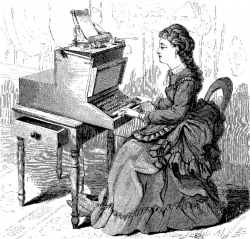
Designed in 1873 by Christopher Latham Sholes, with Carlos Glidden, Samuel Soulé and Mathias Schwalbach, the Sholes & Glidden 'Type Writer' was the first commercially successful device that rapidly printed alphanumeric characters on paper in any order.
YearAdded:
Image Credit: Public Domain (Produced prior to 1/1/1923)Image Caption: Sholes & Glidden 'Type Writer'Era_date_from: 1873
2011
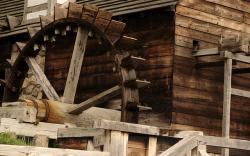
The Saugus Ironworks, the first commercial ironworks in North America, was an impressive technological achievement for an early colony. The same basic processes are used today: reducing iron oxide with carbon to produce metallic iron that can be cast in a mold, producing wrought iron by puddling cast iron, and fabricating wrought iron with power hammer and rolls.
YearAdded:
Image Credit: Courtesy Flickr/Kristin Shoemaker (CC BY-ND 2.0)Image Caption: One of the Saugus Ironworks' water wheels in motionEra_date_from: 1647
1975
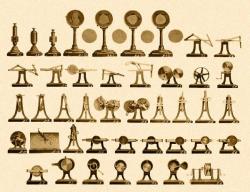
Kinematics is the study of geometry of motion. Reuleaux designed the models in the Cornell collection as teaching aids for invention, showing the kinematic design of machines. The mechanisms in the collection represent the fundamental components of complex machines and were conceived as elements of a basic “language of invention.” Today the models are still used in the teaching of machine design and synthesis, robotics, dynamics, architectural drawing and mathematics.
YearAdded:
Image Credit: Courtesy ASMEImage Caption: A page taken from Gustav Voigt's catalog of Reuleaux's Mechanisms,Era_date_from: 1882
2004
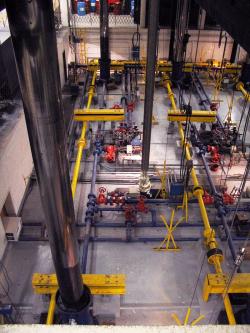
The precision "choreographed" staging of Radio City Music Hall offers size and versatility, unlike any other. Built in 1932 by Peter Clark, its innovative elevator system is a forerunner of other stage designs (including the Metropolitan Opera House) as well as aircraft carrier systems built in World War II. These elevators can handle people, animals, props and scenery at variable speeds, delivering them to the stage or above and also dropping out of sight in front to reappear again in the back, just as effectively.
YearAdded:
Image Credit: Public Domain (Author's Choice)Image Caption: Underneath the Orchestra Lift at the Radio City Music Hall
2001
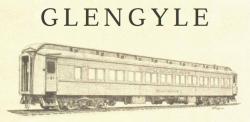
The Glengyle is the earliest known survivor of the fleet of heavyweight, all-steel sleepers built by Pullman Company. The design was introduced in 1907 as a marked improvement over the wooden version then in use. Some 10,000 were built, in various configurations, the last in 1931. The Glengyle is original in its interior and most of its components.
YearAdded:
Image Credit: Courtesy ASMEImage Caption: Pullman Sleeping Car GlengyleEra_date_from: 1911
1987
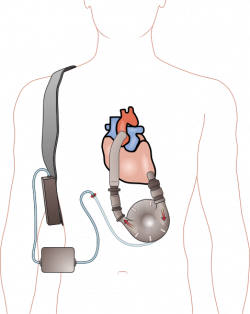
This is the first extremely smooth, surgically implantable, seam-free pulsatile blood pump to receive widespread clinical use. In its use in more than 250 patients, it has been responsible for saving numerous lives. When used as a bridge to transplant, the pump has a success rate greater than 90 percent. There has never been a device-failure-related fatality of any of these patients. A successful heart-assist pump could save an estimated fifteen thousand individuals annually.
YearAdded:
Image Credit: Courtesy Wikipedia/Madhero88 (CC BY-SA 3.0)Image Caption: Pierce-Donachy Ventricular Assist DeviceEra_date_from: 1973
1990
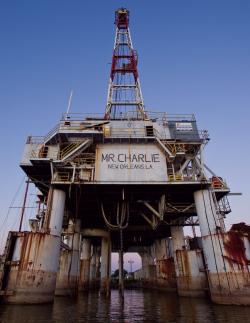
Designed by Alden “Doc” Laborde, Mr. Charlie is the first offshore drilling rig that was fully transportable, submersible and self-sufficient, allowing it to drill more than 200 oil and gas wells along the Gulf Coast between 1954 and 1986.
YearAdded:
Image Credit: Courtesy ASMEImage Caption: Mr. Charlie Oil Drilling RigEra_date_from: 1953
2012
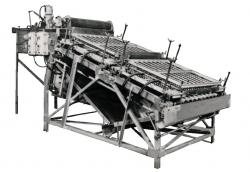
The growth of the shrimp processing industry and its impact on local economies along the northern Gulf of Mexico, The U.S. West Coast and in more than forty other countries is largely attributable to the “machine that peels shrimp,” invented by sixteen year old James Martial Lapeyre from Houma, Louisiana,.
The current Laitram Machinery Model A Automatic Shrimp Peeler is virtually identical to the first unit that was put into commercial use in 1949. Each machine peels approximately 1,000 pounds of shrimp an hour, ranging in size from 10 to 200 count per pound.
YearAdded:
Image Credit: Courtesy ASMEImage Caption: Lapeyre Automatic Shrimp Peeling MachineEra_date_from: 1949
2004
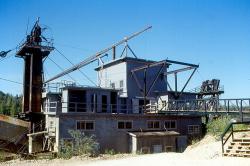
This floating dredge is one of the last mammoth gold dredges in the Fairbanks Mining District that traveled an ancient stream bed, thawing the ground ahead of it and scooping up the gravel. During 32 years of operation, a fortune in gold washed through its sluices. Ladder dredges came to Alaska in the early 1920s, after the U.S. Smelting, Refining, and Mining Company (USSR&M) brought water to the area via the 90-mile Davidson Ditch. Using the water to warm the ground, the ground was thawed at an average 9 inches a day.
YearAdded:
Image Credit: Courtesy Flickr/Roger Wollstadt (CC BY-SA 2.0)Image Caption: Fairbanks Exploration Company Gold Dredge No.Era_date_from: 1928
1986
Innovations